1300 760 441
 cs@factoryfast.com.au
Massage Chairs and Recliners Buyer Guide: How to Choose the Right Chair
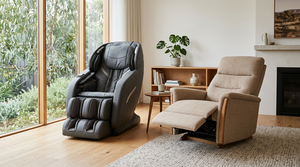

The wrong recliner can be comfortable for ten minutes yet frustrating to live with. It may need more floor space than expected, place its massage points in the wrong areas, feel too deep for the main user or require a manual movement that does not suit the household.
Choosing between massage chairs and recliners therefore starts with the chair’s everyday job. Some buyers want a supportive television chair with occasional vibration and heat. Others need powered adjustment, a lift function or a seat that can turn towards different parts of an open-plan room.
This buyer guide compares those options by function, dimensions, capacity, upholstery, controls and room fit. Work through those decisions in order and you can avoid paying for features that will rarely be used while overlooking the measurements that determine whether the chair is genuinely comfortable.
Compare the Main Types of Massage Chairs and Recliners
The category includes several configurations that can look similar online but behave differently in a living room. The clearest way to compare them is by movement first and massage system second.
Heated swivel massage recliners suit flexible living spaces
A swivel massage recliner can turn towards a television, conversation area or window without requiring the entire chair to be moved. This configuration suits an open-plan room or a seat used for several activities during the day.
Look at the swivel range, reclining action and full unfolded length. A 360-degree base provides broad directional movement, but the surrounding area still needs to remain clear enough for the chair and user to turn. Nearby side tables, floor lamps and sofa arms can restrict a swivel function even when the chair itself fits the available floor area.
Many accessible models use vibration points rather than travelling massage rollers. Vibration can add relaxing movement through the back, waist, thighs or legs, while heat provides another comfort setting. Buyers wanting a particular massage sensation should confirm the mechanism rather than assuming every chair delivers the same type of movement.
Power recliners provide controlled adjustment
An electric recliner uses a powered mechanism to move between sitting and lounging positions. It can be a practical choice when the main user wants gradual adjustment without operating a manual lever or shifting body weight to close the footrest.
Check whether the backrest and footrest move together, the maximum recline angle and which controls remain accessible in every position. Power operation also means planning around an outlet and a sensible cable route. Do not assume the supplied lead will reach the intended position without checking the product information and room layout.
Power-lift recliners support the sitting-to-standing transition
A lift recliner tilts its seat forward as well as reclining backwards. It suits buyers who place a high priority on powered movement when getting into or out of the chair.
The lift angle matters, but it should not be assessed alone. Seat height, depth, armrest position and the user’s ability to place their feet comfortably also affect how useful the movement feels. The chair needs open space in front during the lifting cycle, with controls positioned where the seated user can reach them easily.
A power-lift function is not automatically the best choice for everyone. A buyer who mainly wants to swivel between viewing areas may prefer a rotating base, while someone who values powered positioning could find the lift configuration more relevant than full rotation.
Start With the Chair’s Primary Job
Feature lists become easier to judge once you decide what the chair must do most often. Build the shortlist around one primary use and treat everything else as a supporting benefit.
For television viewing and reading
Prioritise head support, backrest angle, armrest position and a footrest that supports the legs without creating an awkward knee position. Cup holders and storage pockets can keep remotes, reading glasses and small items close, although those conveniences should not outweigh seat fit.
A chair used for reading also needs suitable task lighting. Check whether a floor lamp can sit beside the recliner without restricting its movement and whether the user can reach the switch from the seated position.
For regular relaxation sessions
Compare massage zones, available settings, remote layout and heat function. More features do not automatically create a better experience. A straightforward control system can be more useful than numerous settings if the chair will be used by someone who prefers quick, repeatable adjustment.
Identify the desired body areas before buying. A model with vibration through the back, waist, thighs and legs is a different proposition from one focused mainly on the back. Product descriptions should state the actual massage arrangement; if that detail is absent, confirm it rather than inferring coverage from the chair’s appearance.
For easier powered movement
Give greater weight to the electric lift and recline mechanisms, seat proportions and remote accessibility. Separate controls for movement and comfort settings can make the functions easier to distinguish while seated.
Also consider what happens if the chair is shared. The movement range must suit each regular user, and the controls should be understandable without repeatedly consulting the manual. A chair selected for one person’s preferred lounging angle may feel too deep, too tall or insufficiently supportive for another.
Measure the User as Carefully as the Room
External dimensions tell you whether a chair occupies the room. They do not tell you whether it fits the person sitting in it.
Check seat height and foot contact
When upright, the main user should be able to sit with their feet supported rather than hanging above the floor. A seat that is too high can place pressure behind the legs, while a low seat may make standing more demanding.
Product pages do not always state individual seat dimensions. Where seat height, width or depth is missing, ask for the measurement before treating the model as a confirmed fit. Overall chair dimensions cannot reliably substitute for the usable seating area because armrest thickness and cushioning vary.
Compare seat depth with leg length
A deep recliner may suit a taller user but leave a shorter person unable to sit against the backrest while maintaining a comfortable knee position. Extra cushions can change the fit, but they may also alter where the built-in massage points contact the body.
The backrest should support the intended areas without forcing the shoulders forwards. For a massage model, consider where the user’s back, waist and thighs will align with the listed vibration zones. This is especially important when several household members have noticeably different heights.
Treat the weight capacity as a firm filter
The user’s weight must remain within the stated product capacity. Do not choose a chair right at the limit if the product may be used with heavy items placed on the seat or regularly subjected to abrupt movement.
The current Factory Fast examples discussed below both state a 150 kg capacity. That figure should be checked on the exact live product page at the time of purchase, as specifications can change between visually similar models.
Measure Upright, Reclined and Moving Footprints
One of the most common buying mistakes is marking only the chair’s upright dimensions. Recliners need a three-dimensional movement zone, not just a parking position.
Mark the full floor area
Use removable tape to mark the listed width and upright depth on the floor. Then extend the outline to the stated unfolded length, where available. Sit a dining chair or existing armchair within the template to understand how the proposed recliner will relate to the television, sofa and walkways.
The brown swivel model reviewed for this guide measures 82 cm wide, 96 cm deep and 106 cm high when upright, extending to 163 cm when unfolded. That additional 67 cm changes where the chair can sit in relation to a wall, central table or circulation route.
Allow for every moving component
A reclining back may move towards the wall while the footrest extends into the room. A swivel base creates a rotating footprint, and a lift chair moves forward during operation. Test the complete range rather than assuming the chair only becomes longer in one direction.
Check nearby doors, curtains, power points, heater locations and cabinet openings. If a coffee or side table sits within the seating zone, use the measurements in the coffee tables and end tables buyer guide to plan reachable surfaces without blocking the recliner.
Measure the delivery path
Record doorway widths, hallway turns, stairs, lift access and the final room entrance. Compare those points with the packaged dimensions where supplied, not merely the assembled chair.
Both featured models are flat-packed, but that does not mean every package will pass through a tight corner or be easy for one person to move. Review the current delivery information and arrange appropriate unloading and assembly help before the chair arrives.
Compare Massage, Heat and Control Features
The word “massage” can describe different mechanisms. Buyers should focus on how the feature works, where it operates and how much control the chair provides.
Understand the massage mechanism
The verified Factory Fast models in this guide use eight vibration points. That is distinct from a chair with travelling rollers or an air-compression system. Vibration suits buyers seeking a gentle moving sensation during everyday lounging, but it should not be mistaken for a different mechanism.
Read the stated massage zones closely. Coverage through the back, waist, thighs and legs provides broader contact than a back-only arrangement. The user’s height still affects alignment, so the number of zones is only useful when they correspond with the intended parts of the body.
Decide whether heat will be used
Integrated heat can add warmth during a seated relaxation session. It is most relevant to buyers who expect to use it regularly, particularly during cooler weather, rather than those attracted to a longer feature list.
Check whether heat can be controlled separately from vibration. Separate adjustment gives the user more flexibility than a system that activates both functions together. Anyone with a health condition, reduced temperature sensitivity or concerns about heat and massage should seek individual professional guidance before use.
Inspect the remote arrangement
A remote should be reachable, legible and easy to return to a consistent storage location. A model with separate movement and massage controls may make each function clearer, while a single remote can reduce the number of accessories beside the chair.
Storage pockets help prevent remotes from disappearing between cushions or across the room. Cup holders can also be useful, but their position should not interfere with arm support or make controls harder to reach.
Compare Verified Factory Fast Models
Two current models illustrate the difference between a swivel-led recliner and a powered lift chair. Prices are included only as a point-in-time comparison and should be rechecked before ordering.
Heated swivel recliner for flexible positioning
The brown heated massage chair with a 360-degree swivel base combines eight heated vibration points across the back, waist, thighs and legs with an adjustable backrest and leg rest.
It measures 82 × 96 × 106 cm and extends to 163 cm when unfolded. The chair uses PU leather upholstery, sponge padding and a steel base, includes two cup holders and has a stated 150 kg capacity. It was listed at $602.96 when researched.
This model best suits a buyer who values rotation, manual reclining and broad vibration coverage. Its full unfolded length and rotating base should be mapped carefully in a compact lounge.
Electric recliner for powered adjustment and lift assistance
The electric recliner with massage, heat and power lift provides a lift angle of up to 34 degrees and a recline angle of up to 155 degrees.
Its listed dimensions are 105.5 × 83 × 95 cm in height, width and length. The structure combines timber and metal with high-resilience foam and black PU leather. It also provides eight massage points, heat, two remotes, four pockets, two cup holders, integrated wheels and a 150 kg capacity. The researched price was $719.95.
The page does not state the chair’s complete extended floor length. Buyers should confirm that measurement before ordering rather than relying on the upright 95 cm length. This option is better aligned with households prioritising powered movement and lift functionality over a swivel base.
Choose Upholstery for Real Household Use
PU leather creates a smooth, uniform surface and can be wiped during regular care. It can suit a living room where spills, dust or frequent use make straightforward cleaning important.
Colour affects more than styling. Black creates stronger visual weight, while brown can connect with warm timber finishes and traditional living-room furniture. Look at the chair beside the existing sofa, flooring and cabinetry rather than judging the finish on an isolated screen.
Cushioning also deserves attention. A thickly padded chair may feel inviting, but very soft cushioning can change the seated height and make movement more demanding for some users. Firmer support may be preferable for a frequently used television chair. Because comfort is personal, compare the stated padding material and return terms before ordering.
Follow the exact product-care directions for the chosen upholstery. Deal with spills promptly, use a soft cloth and avoid assuming that a general household cleaner is suitable. Heat, direct sunlight and repeated rubbing can affect upholstered surfaces, so placement and routine care contribute to long-term appearance.
Judge Value by Useful Features, Not Feature Count
At the time of research, the two verified chairs ranged from $602.96 to $719.95. The difference reflects more than appearance: the higher-priced model adds powered reclining, a forward lift function, dual controls, storage pockets and wheels, while the lower-priced option provides a swivel base and a stated full unfolded length.
The better-value chair is the one whose added functions solve an actual household need. A lift mechanism may justify the additional cost when powered transitions are a priority. A swivel configuration may deliver more practical flexibility in an open-plan room where the seat changes direction throughout the day.
Before checkout, compare the product price with the complete ownership requirements. Account for delivery access, assembly, available power, floor protection and any nearby table or lighting changes needed to make the chair work properly.
Browse the broader living room furniture range only after the recliner’s movement zone has been fixed. Adding surrounding furniture first can leave the most mechanically complex seat with insufficient room to operate.
Complete a Final Chair Check Before Ordering
Confirm the primary user, most frequent activity and preferred movement type. Then verify the chair’s upright dimensions, full extension, swivel or lift zone, capacity, massage mechanism, heat controls, upholstery, power needs, assembly requirements and delivery route.
For a shared chair, repeat the fit check for every regular user. The strongest compromise is not necessarily the model with the largest capacity or most settings; it is the one that supports each person’s feet, legs and back without making operation unnecessarily complicated.
As a final test, mark the complete moving footprint and leave it in place for a full evening. Walk through the room, open nearby storage, use the coffee table and approach the seat from the usual direction. A recliner that still works after the room has been used normally has passed a more meaningful test than one judged only by its upright dimensions.
Frequently Asked Questions
How much room do I need behind a reclining massage chair?
The required clearance depends on how the backrest, footrest and base move. Mark both the upright footprint and the fully extended length stated on the product page, then check the space behind and in front. A swivel chair also needs clearance at its sides. If the extended measurement is not published, confirm it before ordering rather than estimating from the upright depth.
Is a power-lift recliner different from an electric recliner?
Yes. An electric recliner uses powered adjustment to move into lounging positions, while a power-lift model also tilts forward to support the transition from sitting to standing. Some chairs combine both functions with massage and heat. Compare the lift angle, recline range, seat dimensions and controls because the presence of a lift motor does not guarantee a suitable fit for every user.
Are heated massage recliners suitable for everyday use?
A heated massage recliner can be used as everyday seating when its dimensions, support and controls suit the user. Start with moderate settings and follow the instructions supplied with the exact model. Heat and vibration are comfort features rather than substitutes for individual medical care. People with health conditions, reduced sensation or concerns about massage should obtain appropriate professional advice before regular use.
Do massage recliners arrive assembled?
Assembly requirements vary, but both Factory Fast chairs featured in this guide are listed as flat-packed. Check the current product page for package details, supplied components and required assembly before delivery. Measure doorways and corners using the packaged dimensions where available. Large chair components can still be awkward to move, so organise suitable unloading and assembly help rather than relying on the flat-packed description alone.
How do I clean a PU leather massage chair?
Use the care instructions supplied with the chair. For routine cleaning, remove dust with a soft cloth and wipe suitable spills promptly without saturating seams, controls or electrical areas. Avoid abrasive tools and do not assume every household cleaning product is compatible with PU leather. Keeping the chair away from excessive heat and strong direct sunlight can also help preserve its surface appearance.
Is a massage chair worth buying for a small living room?
It can be, provided the complete movement zone fits without blocking doors, walkways or nearby furniture. A compact upright footprint is not enough; include the reclining length, footrest extension and any swivel or lift movement. Tape those boundaries onto the floor and use the room normally. A model that preserves practical circulation while delivering the functions you will use regularly can justify its space.
 Tags: