1300 760 441
 cs@factoryfast.com.au
Coffee Tables and End Tables Buyer Guide: Choosing Size, Shape and Function
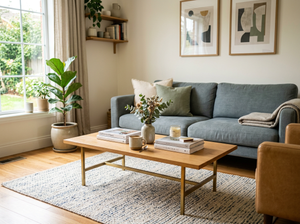

A living room table can look perfectly proportioned online and still feel awkward once it is placed between a sofa, armchairs and the main walkway. The problem is rarely style alone. An unsuitable table may sit beyond comfortable reach, restrict movement, provide too little usable surface or make a compact room feel crowded.
The practical difference between coffee tables and end tables is where and how they are used. A coffee table usually serves the whole seating arrangement from a central position. An end table provides a closer personal surface beside a sofa or chair. Some rooms benefit from both, while smaller spaces may work better with nesting or movable designs that perform more than one role.
Use this guide to compare Factory Fast’s range of coffee tables and end tables by function, dimensions, shape, material, storage and placement.
Coffee Table or End Table: Which Does Your Room Need?
The first decision is not round versus rectangular or timber-look versus marble-effect. It is whether the table needs to serve the room, an individual seat or both.
Choose a coffee table for a shared central surface
A coffee table works best when several seats need access to one common surface. It can hold drinks, books, remotes and serving pieces while visually anchoring a sofa arrangement. Its central position also makes it useful for casual activities that require more tabletop area.
This format suits a living room where the sofa and chairs face towards a shared centre. The table should be large enough to relate to the main sofa without extending so far that people must manoeuvre around its corners.
A fixed design makes sense when the seating rarely moves and there is enough room to preserve clear pathways. A smaller or nesting model is more useful when the space must change between everyday living, entertaining and open floor area.
Choose an end table for close-range convenience
An end table sits beside a sofa or armchair, keeping personal items within easy reach. It is particularly useful for a reading seat, a lounge with wide arms or a room where a central table would interrupt movement.
The best height depends on the furniture beside it. Measure from the floor to the part of the sofa or chair from which you will reach. A surface close to the arm height is generally easier to use than one that requires a deep bend or an upward reach.
End tables also help separate functions. The central surface can remain uncluttered while a lamp, charging items or frequently used accessories stay beside one seat.
Use both when the room has distinct seating zones
A larger lounge may need a central table for shared use and one or two side surfaces for individual seats. Matching every piece is unnecessary. Repeating a finish, frame colour, shape or visual weight can create enough connection without making the room appear like a rigid furniture set.
Before adding several pieces, assign a purpose to each one. A table that has no clear role often becomes a clutter point and consumes space that would be better left open.
Set the Right Dimensions From the Room and Sofa
Product measurements only become useful when compared with the space around the furniture. Measure the assembled footprint, not merely the empty patch of floor where you think the table will go.
Start with the usable floor area
Record the distance between the sofa and opposing seats, the position of doorways and the routes people use to cross the room. Factory Fast’s living room furniture guidance recommends allowing approximately 35–45 cm between a coffee table and seating, with about 75–90 cm for a main walkway.
Treat those figures as layout checks rather than a substitute for testing your room. Deep sofas, recliners and narrow lounge areas may change what feels comfortable. Reclining seats also need their full movement zone kept free.
Mark the proposed tabletop outline on the floor with removable tape or sheets of paper. Walk past it, sit down and reach towards it. This simple test reveals intrusive corners and undersized surfaces more reliably than looking at an isolated product measurement.
Compare width with the main sofa
A coffee table should feel connected to the sofa without spanning the entire seating width. An overly short design can appear visually disconnected and may be useful to only one seat. An excessively long model can dominate the setting or obstruct access to the outer seats.
Instead of relying on a universal ratio, consider who needs to reach the surface. A household that uses every sofa position may prefer a broader top. A compact lounge used mainly by one or two people can support a shorter design while retaining more open floor area.
Check height from the seated position
Table height affects both comfort and visual balance. A low surface can make a room feel open, but it may be inconvenient for anyone who finds bending difficult. A taller design brings drinks and devices closer, although it can interrupt sightlines if it rises well above the sofa seat.
Compare the listed height with the actual seat cushion after someone is sitting on it. Soft cushions compress, so an unloaded sofa measurement may not represent the real reaching position.
The same principle applies beside an armchair. Account for the chair arm, the user’s preferred side and any controls or reclining mechanisms before choosing an end table height.
Compare Round, Oval, Rectangular and C-Shaped Tables
Shape determines more than appearance. It affects usable surface area, how people move around the furniture and where the piece can sit.
Round tables soften tight circulation paths
A round coffee table removes projecting corners, which can make movement easier where several routes meet around the seating. It also works well with curved furniture or a conversational arrangement in which chairs face inward from different angles.
The trade-off is that a circular top may leave more unused floor area at its corners than a rectangular design occupying a similar overall width. Check the diameter against the narrowest part of the room and confirm that each important seat remains within practical reach.
Round nesting tables are especially adaptable because the smaller piece can be moved towards an occasional chair when required.
Oval tables balance surface area and softer edges
An oval top offers some of the length of a rectangular table while maintaining curved ends. This can suit a longer sofa in a room where square corners would project into a walkway.
For example, Factory Fast’s compact oval coffee table measures 80 × 55 × 38 cm and has a stated tabletop capacity of 68 kg. Those dimensions create a relatively low, compact centrepiece. Buyers should still map the full 80 × 55 cm footprint and compare the 38 cm height with their own sofa before deciding that it fits.
Rectangular tables suit linear furniture arrangements
A rectangular design naturally follows the line of a straight sofa. It usually provides efficient surface area for its footprint and can make serving several seats easier.
Corners require more attention in narrow rooms. Check whether anyone entering the seating area must turn closely around an edge. The table should not force people to move sideways between furniture or block the natural approach to the sofa.
C-shaped tables bring the surface closer
A C-shaped base is designed to slide beneath compatible seating, bringing the top over or close to the user’s lap. It can work as a laptop surface, snack table or compact alternative to a central piece.
The C-shaped sofa side table measures 40 × 60 × 70 cm and combines a wood-look surface with a metal frame and lower shelf. Before choosing this style, measure the clearance beneath the sofa as well as the height and depth around the arm. A C-frame is only useful when its base can move into the intended position without meeting a low rail, leg or reclining component.
Decide Between Fixed, Nesting and Movable Designs
The right configuration depends on whether your living room stays arranged one way or regularly changes function.
Fixed tables favour consistency
A single fixed table provides a stable centre for a room with a settled layout. It is a sensible choice when the surface is used every day and does not need to be cleared away for exercise, play or additional seating.
Give priority to the correct footprint and height. Decorative features cannot compensate for a table that interferes with circulation or sits too far from the sofa.
Nesting tables create surfaces on demand
A nesting set allows two tables to occupy a layered area when stored and separate when another seat needs its own surface. This makes the format useful in apartments, multipurpose rooms and homes that entertain occasionally.
Factory Fast’s reversible nesting coffee table set includes a 70 × 70 × 44 cm table and a 50 × 50 × 39 cm companion. Each has a stated 50 kg capacity, with MDF tops, 1.2 mm steel frames, reversible black-and-white surfaces and anti-slip rubber feet.
The smaller component still needs somewhere to go when separated. Measure both the nested arrangement and the two-table layout. Otherwise, a feature purchased to save space may create a second obstruction whenever it is used.
Lightweight end tables support changing routines
A movable side table can follow the preferred seat, shift away when more floor space is needed or serve as an occasional surface for visitors. Look beyond the product weight and consider how it will be handled. A broad top with a narrow base may be awkward to carry even if it is not especially heavy.
Floor contact also matters. Check the type of feet supplied and whether they suit the flooring beneath the table. Lift furniture when repositioning it rather than dragging it across the room.
Choose Materials for the Way the Table Will Be Used
A finish should suit the room visually, but the daily workload is the more important filter. Consider spills, heat, cleaning habits, pets, children and the objects likely to remain on the surface.
MDF and laminated surfaces
MDF provides a smooth base for wood-look, marble-effect and coloured finishes. A laminated or coated surface can be straightforward to wipe clean, making it practical for everyday living areas.
Moisture should not be allowed to sit around joints or exposed edges. Use a lightly damp cloth, dry the surface promptly and avoid abrasive cleaners that may dull or mark the finish. Coasters and mats can also reduce repeated contact from wet or warm items.
Timber and timber-look finishes
Timber brings visible grain and warmth, while timber-look finishes offer a similar visual direction with different construction and care requirements. Read the product description carefully rather than assuming that a wood appearance indicates solid timber throughout.
The surrounding room does not need identical timber tones. A table can coordinate with existing furniture through warmth, contrast or a repeated leg colour. Comparing samples and product images under the room’s daytime and evening lighting will give a better indication than matching colour names alone.
Metal frames
Metal bases can create a visually lighter profile because narrower structural members leave more open space beneath the top. They also pair readily with timber-look, laminate and marble-effect surfaces.
Inspect the frame layout as part of the fit assessment. Crossbars, circular bases and angled legs can occupy foot space or affect how closely the table sits beside other furniture. Check that all supplied fixings are tightened evenly during assembly and review them periodically if the piece is moved often.
Match Storage to Real Living Room Habits
Storage is valuable only when it suits the objects that need a home. Extra shelves and compartments can otherwise add visual bulk without making the room easier to use.
Open shelves suit frequently used items
A lower shelf keeps books, magazines and small baskets off the main tabletop while leaving them visible. This works well for items used regularly and for households that prefer quick access.
Measure the vertical space between the shelf and top. A broad storage area may still be unsuitable if the objects you intend to place there are too tall. Open storage also requires some discipline because its contents remain part of the room’s appearance.
Concealed storage reduces visual clutter
Drawers or lift-up compartments can hide remotes, charging cables and other small accessories. They suit living rooms where the table needs to look clear between uses.
Check how the storage opens. A drawer requires clearance on one side, while a lifting top changes the usable space above the table and may require items to be moved first. Confirm the opening direction against the sofa rather than evaluating the feature in isolation.
A clear tabletop may be the better choice
Not every household needs integrated storage. A simple surface is easier to reposition and can feel less imposing in a compact room. Storage may be better handled by a nearby TV cabinet or bookshelf if those items need to be organised by category rather than placed beneath the central table.
List what currently accumulates around the sofa for one week. That list will show whether you need a shelf, concealed compartment, larger surface or simply a more deliberate place for a few essentials.
Coordinate the Table With the Whole Living Room
A table should relate to the room without matching every item exactly. Start with the dominant forms already present: straight or curved lines, open or solid bases, warm or cool finishes and visually heavy or lightweight furniture.
Repeat one or two elements rather than all of them. A black metal frame can connect with lighting or cabinet hardware, while a wood-look top can introduce warmth beside upholstered seating. A marble-effect surface may act as a brighter focal point in a room with simpler finishes.
Scale is just as important as colour. A delicate side table may look lost beside a deep, substantial sofa, while a bulky central piece can overwhelm compact seating. View the dimensions as a three-dimensional volume, including height and base structure, rather than judging the tabletop alone.
Also consider what happens beneath and around the furniture. A rug can define the seating zone, but the table feet need to sit consistently and without rocking across raised edges. Nearby drawers, cabinet doors and reclining seats should all be tested through their complete range of movement.
Check Product Details Before Ordering
Before selecting a coffee or end table, confirm:
- The assembled width, depth or diameter and height
- Clearance between the table, seating and main walkway
- Whether a C-shaped base fits beneath the intended sofa
- The tabletop and frame materials
- The stated weight capacity
- Shelf or compartment dimensions where storage matters
- The direction and clearance needed for moving parts
- Whether assembly is required and what is included
- The floor-contact design and cleaning instructions
- The packaged size and the delivery path into the room
Do not use a stated load rating as a substitute for checking stability, dimensions or intended use. Weight should be distributed sensibly, and the product should stand level with all fittings correctly installed.
Before checkout, cut or fold a piece of cardboard to the full tabletop dimensions and leave it in the proposed position for an evening. Use the sofa, open nearby storage and walk the usual routes. If the template remains convenient after the room has been used normally, the chosen footprint has passed a far more meaningful test than appearance alone.
Frequently Asked Questions
How far should a coffee table be from the sofa?
Allow approximately 35–45 cm between the sofa and coffee table as a practical starting point. This usually keeps the surface reachable while leaving room for legs and movement. Test the distance from every regularly used seat, especially with a deep sofa or soft cushions. Recliners require additional clearance for the footrest and should be checked in their fully extended position.
Should a coffee table be higher or lower than the sofa seat?
A coffee table commonly works best near the sofa’s seated cushion height or slightly below it. The ideal position depends on how easily users can bend and reach, so measure the cushion while someone is sitting on it. Compare that figure with the product’s assembled height. A very low design may look streamlined but can be inconvenient for frequent drinks, meals or device use.
Are round or rectangular coffee tables better for small rooms?
Round and oval tables can make circulation easier where corners would project into a narrow route. Rectangular designs generally align efficiently with straight sofas and provide useful surface length. The better choice depends on the room’s actual pathways, not shape alone. Mark the full footprint on the floor and retain enough space to approach the seating without turning sideways around the table.
Do end tables need to match the coffee table?
End tables do not have to be identical to the coffee table. A coordinated room can repeat one feature, such as frame colour, curved edges, material warmth or overall visual weight. Different designs may be more practical when each seat has different clearance or storage needs. Keep their relationship intentional so the variation looks collected rather than accidental.
Are nesting coffee tables suitable for everyday use?
Nesting tables suit rooms that need a compact arrangement most days and extra surfaces at other times. Check both the nested footprint and the space required when each piece is separated. The smaller table should have a planned position beside a chair or sofa. Compare the dimensions, materials and stated load capacity of each component instead of assuming both pieces perform identically.
How should coffee tables and end tables be cleaned?
Follow the care directions for the exact surface. Laminated and coated tops generally need a soft, lightly damp cloth followed by prompt drying, while abrasive products may damage the finish. Wipe spills before moisture reaches exposed edges or joints. Use coasters or mats for wet and warm items, and lift the table when repositioning it to help protect both its feet and the flooring.
 Tags: