1300 760 441
 cs@factoryfast.com.au
How to Choose a Bed Frame for a Small Bedroom: Size, Storage and Layout Guide
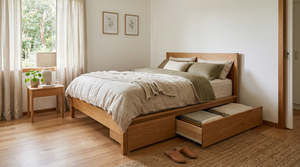

A small bedroom does not automatically need the smallest bed available. It needs a bed that leaves the rest of the room working properly. The wardrobe still has to open, the desk chair needs somewhere to move, and the sleeper should be able to reach the doorway without negotiating protruding rails or a bulky footboard.
The right bed frame for a small bedroom therefore depends on more than mattress size. External frame dimensions, storage access, headboard depth, assembly requirements and the room’s second purpose can all change which option fits best.
This guide takes a project-planning approach: measure the fixed limits first, identify what the room must do, and then choose the frame size and configuration that preserve those functions.
Measure the working room, not just the empty floor
A room can appear large enough for a bed while it is empty. The more useful question is whether the same space still works after the mattress, frame and essential furniture are in position.
Mark the fixed boundaries
Start by recording the length and width of the room. Then mark every feature that limits furniture placement:
- the doorway and its full swing
- built-in wardrobe doors and drawers
- windows and their opening direction
- power points needed beside the bed
- skirting boards or wall projections
- desk, dresser and bedside storage positions
- any route used to reach another part of the room
Do not measure only the uninterrupted wall length. A bed placed along that wall may still obstruct a wardrobe opposite it or leave nowhere to pull out a desk chair.
Painter’s tape is useful for testing the footprint. Mark the proposed external dimensions on the floor, then open every door and drawer around it. This makes awkward corners and lost access visible before a frame is ordered.
Separate essential and optional furniture
List the items the room must contain. A child’s room may need open play space and a desk. A guest room may also function as a home office. A compact adult bedroom might require accessible clothing storage but no bedside table on both sides.
Treat optional furniture as flexible. A narrow shelf may replace a traditional bedside unit, or a wall-mounted light may free the floor beside the headboard. The bed itself is harder to adjust after purchase, so confirm its footprint before planning decorative additions.
Choose the bed size around the sleeper and the room’s job
The best size is the smallest option that comfortably supports the intended sleeper for the expected period of use. Choosing solely for maximum open floor area can result in a bed that becomes unsuitable too quickly.
When a single frame makes sense
A single bed is often the most practical choice for a child, an occasional guest or one adult who prioritises floor space. Factory Fast product listings use a 92 x 187 cm mattress size for selected single frames.
The single bed frame collection is a useful starting point when the room must also accommodate a desk, wardrobe or play area. A narrow sleeping footprint can leave more flexibility for future layout changes.
Remember that 92 x 187 cm describes the compatible mattress or internal sleeping area on relevant listings. Decorative headboards, side rails and footboards can make the assembled product wider or longer.
When a king single earns its extra space
A king single is worth considering for a teenager, taller child, adult or regularly used guest room. Selected Factory Fast models accommodate a 107 x 203 cm mattress, adding both width and length compared with a single.
That difference may be worthwhile if the bed needs to remain suitable as a child grows. It can also provide a more generous adult guest bed while occupying less width than a double. Browse the king single bed frame range when sleeping comfort matters but the room cannot comfortably support a wider option.
The extra length is easy to overlook. Check the space at the foot of the bed, particularly when the entrance, wardrobe or desk is located on that side. The existing single and king single bed frame guide provides a deeper comparison for children, guests and compact rooms.
When a double bed becomes a layout compromise
A double can suit a compact room used by a couple or an adult who values a wider sleeping surface. It becomes a poor fit when the increased width removes access to storage or forces other essential furniture into the walking path.
Do not judge the fit from the mattress alone. A double frame with a substantial headboard, thick upholstered rails or a projecting footboard may occupy considerably more space than a simple base. Compare the complete assembled dimensions of each shortlisted product.
Check the external frame footprint before comparing styles
Mattress compatibility tells you what sits on the frame. It does not necessarily tell you how much of the room the finished product occupies.
Account for every projection
Check the product page for assembled width, length and height. If only mattress compatibility is listed, treat the full external footprint as unconfirmed and verify it before publishing or purchasing.
Pay particular attention to:
- headboards that extend beyond the side rails
- padded upholstery around the mattress
- angled legs
- footboards that project beyond the sleeping surface
- decorative posts
- drawer handles
- side-mounted hardware
Even a modest projection can affect a narrow path beside the bed. This matters most near doorways and wardrobe corners, where the available clearance may already be limited.
A simple frame can make the planning easier. The Single Metal Bed Frame is listed at 92 x 187 x 30 cm and is designed for a standard Australian single mattress of 92 x 187 cm. Its straightforward footprint suits layouts where unnecessary width or length would make the room harder to use.
Consider height as well as floor area
A low frame can make a compact room appear more open because it leaves more visible wall above the mattress. However, lowering the bed may reduce the height available for storage containers.
A tall headboard creates the opposite trade-off. It can give the bed a finished focal point and provide a backrest, but it also occupies more visual space. Before choosing one, check whether it will sit beneath a window, shelf or wall-mounted fitting.
Bed height also affects how comfortably the intended sleeper can get in and out. Consider the combined height of the base and mattress rather than assessing the frame by itself.
Decide what the space beneath the bed needs to do
Under-bed space can replace a separate piece of furniture, but only when the storage is accessible in the actual room layout. A storage feature that cannot open fully has little practical value.
Open clearance suits flexible containers
An elevated frame with open sides allows boxes or bags to be placed beneath the mattress. It works well when stored items need to be divided into smaller groups or moved between rooms.
The single metal example has 25 cm legs, although the usable container height should be checked against the lowest rail or crossbar rather than the leg measurement alone. Choose containers only after the frame has been assembled and the real clearance is known.
Open storage is easy to adapt, but exposed containers can make the room appear busier. Matching low-profile boxes or containers that sit fully behind the side rail help maintain a calmer look.
Drawers need side clearance
Built-in drawers can organise clothing, spare linen or personal items without separate containers. Their limitation is the floor space required beside the bed.
A drawer facing a wall, wardrobe or desk may not extend far enough to use comfortably. Before choosing this configuration, mark the open drawer depth as well as the closed frame footprint. In a very narrow room, drawers at the foot may be more accessible than side drawers, provided the doorway does not occupy the same area.
Lift-up storage needs vertical access
A lift-up base can use most of the area beneath the mattress without requiring drawer clearance along the sides. It may suit a bed positioned close to a wall, but it still needs enough vertical space to raise the platform and enough room for the user to operate it.
Check mechanism compatibility, mattress requirements and installation details on the individual listing. Do not assume every frame can be converted into a lifting storage bed. These mechanisms are product-specific and may require an appropriate platform structure.
Select a frame material that matches the room’s constraints
Material changes more than the appearance of the bed. It affects visual weight, cleaning, portability, edge thickness and the amount of structure surrounding the mattress.
Metal frames keep the outline visually open
A metal base with narrow rails and open space beneath it can appear less dominant than a solid upholstered structure. This makes it useful where the bed occupies a large share of the visible floor area.
Powder-coated steel also suits buyers who want a straightforward surface to wipe clean. The broader metal bed frame collection includes different sizes and configurations for comparison.
Check the support construction and stated load capacity rather than assuming all metal frames perform the same way. Side-rail dimensions, crossbars, centre supports and slat systems vary between products.
Upholstered frames add comfort but can increase bulk
A padded headboard can be valuable when the bed doubles as a place to read, work or watch a device. Fabric or upholstered rails can also soften the appearance of the sleeping area.
The trade-off is additional thickness around the mattress. Upholstery can increase the external width and may need more regular cleaning, particularly when the side rail sits close to a wall. Check whether the visual and practical benefit justifies the larger outline.
Timber frames can make the bed a stronger feature
Timber can add warmth and suit a room where the bed is intended to be the main furnishing. Solid rails, posts or headboards may create a heavier appearance than an open metal base, although the effect depends on the individual design.
For a small bedroom, compare the depth of the headboard and footboard as carefully as the material. A restrained timber base may fit more efficiently than an upholstered frame with thick padding, while a decorative timber design may occupy more space.
Plan the bed position around daily movement
Placing the headboard against the longest wall is common, but it is not automatically the most useful layout. The correct position depends on who uses the room and which functions need frequent access.
One-side access can recover floor space
Positioning a single bed against a wall can preserve a wider open zone for a desk, play area or storage unit. This arrangement often suits children’s rooms and occasional guest spaces.
For an adult using the bed every night, access from both sides may be more convenient. It also makes changing bedding easier. Decide whether the saved floor area is worth the reduced access rather than following a general layout rule.
Keep the busiest route clear
Identify the path used most often, such as the route from the doorway to the wardrobe. Avoid placing a projecting footboard or bed corner directly in that line.
A clear route can make the room feel more usable even when the total open floor area is modest. Conversely, a large empty patch in one corner does not help if the bed blocks the doors and drawers used every day.
Protect functional wall space
Before centring the headboard, check where bedside power is required and whether the bed will cover useful outlets. Consider whether curtains can move freely and whether the window remains easy to reach.
If the room needs a desk, test the chair in its pulled-back position. A layout that works only while the chair is tucked away will become frustrating during normal use.
Compare support, capacity and mattress compatibility
A compact footprint does not compensate for a frame that is unsuitable for the mattress or sleeper. Structural details should remain part of the decision.
Match the listed mattress size
Confirm that the mattress dimensions on the product page match the mattress you own or intend to buy. Australian single and king single sizes are not interchangeable.
Avoid relying only on labels such as “single”, especially when combining an existing mattress with a new base. Use the stated measurements from both products. Check whether the mattress sits within rails, rests on top of the frame or requires a particular support system.
Read the load rating in context
The stated capacity should account for the mattress and everyone using the bed. Use the individual listing rather than a category-wide assumption.
For example, the King Single Metal Bed Frame is listed at 107 x 203 x 30 cm with an approximate 500 kg static loading capacity. That combination may suit a compact room needing more sleeping length and a clearly specified support rating.
A static rating describes a stationary load under the conditions stated by the seller. It should not be treated as permission to ignore correct assembly or use the frame outside its intended purpose.
Check delivery and assembly before ordering
Small bedrooms can be challenging places to assemble furniture. The route from the entrance to the final position matters as much as the finished dimensions.
Measure the route into the room
Check the front entrance, hallway, stairs and bedroom doorway. Include tight turns and any furniture that cannot be moved. Flat-packed products can be easier to carry through compact homes, but package dimensions and weight still matter.
Do not assume an assembled bed can be rotated into position after construction. Long side rails may strike a wall or wardrobe even when the final footprint fits comfortably.
Assemble the frame near its final position
Clear the room before opening the package. Lay out the rails, supports and hardware in groups, keeping the intended bed orientation in mind.
In a tight room, partial assembly near the final location can reduce the need to lift and turn the completed base. Follow the supplied instructions and confirm that all fasteners are tightened evenly before placing the mattress.
If under-bed containers are part of the plan, wait until the base is complete before buying them. The internal obstructions beneath a frame are not always obvious from its overall height.
Avoid the small-bedroom mistakes that create daily frustration
One common mistake is measuring the mattress and assuming the frame has the same footprint. This can leave too little clearance for a headboard, footboard or padded rails.
Another is choosing storage by volume alone. A drawer can offer generous capacity on paper but remain unusable when it faces a wall. A lift-up design may provide broad access yet be unnecessary for items needed every day.
Buying a bed before deciding the room’s second function is equally limiting. A guest room that later needs a desk may no longer work once a wider frame occupies the chair space. A child’s room may quickly feel crowded if no area is reserved for changing storage and study needs.
Visual scale also matters. A heavy headboard, thick upholstery and multiple decorative features can make a modest frame feel much larger. In rooms with limited wall and floor area, a simpler outline often gives bedding and smaller furnishings more room to carry the style.
Finally, do not overlook maintenance access. Leave a workable way to vacuum beneath or around the frame, retrieve stored items and reach the wall behind the headboard. A bed that technically fits but cannot be cleaned or maintained comfortably is not a successful compact-room choice.
Make the final choice with a one-day floor test
Once you have shortlisted a size, mark the exact external footprint on the floor and leave the tape in place for a full day. Open the wardrobe in the morning, sit at the desk, access the window, carry a laundry basket through the room and approach the bed from the direction you would at night. If those actions repeatedly cross the taped outline, change the bed position or choose a frame without the feature causing the obstruction.
Frequently Asked Questions
Can a double bed fit in a small bedroom?
A double bed can fit if its complete external dimensions leave the doorway, wardrobe and essential furniture usable. Measure the assembled frame rather than relying on the mattress size alone. If the wider base removes desk space or blocks storage, a king single may offer a better balance between sleeping room and usable floor area.
Is a single or king single bed better for an adult?
A king single generally gives an adult more width and length, while a single preserves more floor space. The better choice depends on the sleeper’s height, the frequency of use and the room’s other functions. Compare 92 x 187 cm single compatibility with 107 x 203 cm king single compatibility where those measurements are confirmed on the selected listings.
Is built-in storage better than using boxes under the bed?
Built-in storage is useful when its drawers or lifting mechanism can operate fully in the available space. Separate boxes offer more flexibility and are easier to replace or rearrange. Check the lowest rail or support beneath an open frame before choosing containers, as usable clearance may be less than the height of the bed legs.
Does a bed frame need to match the mattress exactly?
The frame should be explicitly compatible with the mattress size stated on the product page. A loose fit can allow unwanted movement, while an undersized frame will not support the mattress correctly. Match measured dimensions rather than relying only on size names, particularly when using an existing mattress with a newly purchased base.
Can I place a bed against the wall in a small room?
Placing one side against a wall can free space for a desk, wardrobe or open floor area. It often works well for children and occasional guests, although it makes one side harder to access and can complicate changing bedding. Test whether the recovered floor area provides more practical value than access from both sides.
What should renters look for in a small-bedroom bed frame?
Renters should prioritise a frame that is flat-packed, straightforward to disassemble and manageable through the property’s doors and hallways. A simple metal base can also adapt to different room styles and leave flexible storage space beneath. Keep the assembly instructions and hardware organised so the frame can be moved without unnecessary difficulty.
-
 Tags:
Bed Frames