1300 760 441
 cs@factoryfast.com.au
Bed Frames for Heavy Weight Capacity: What to Check Before You Buy

A high number beside “weight capacity” can make a bed frame look like an easy choice. In reality, that figure is only one part of the decision. The frame must also support the correct mattress, distribute weight through a suitable arrangement of rails, slats and legs, remain stable after assembly and fit the bedroom without blocking storage or walkways.
This matters whether the bed is for one sleeper, a couple, regular guests or a household using a particularly substantial mattress. The practical goal is not to buy the frame with the largest number. It is to find a bed base whose stated capacity, construction and dimensions suit the complete setup.
Before comparing options across the bed frames collection, work through the decision in the following order: required load, mattress compatibility, support structure, assembled footprint, bed height, assembly and ongoing access to fasteners. That sequence prevents a strong-looking frame from becoming the wrong frame for the room.
Understand What a Bed Frame Weight Capacity Tells You
A weight capacity is the load figure stated for a particular product. It should be treated as specific to that frame, not as a general rating that applies to every metal, timber or upholstered bed of the same size.
The first question is what the listed figure covers. A bed must carry the mattress as well as the person or people using it. Bedding and anything else regularly placed on the bed also contribute to the total load. If a product page does not clarify whether its capacity includes the mattress, do not automatically treat the entire figure as available for sleepers.
Some listings may identify a static load capacity, which refers to weight supported while relatively still. Ordinary bedroom use also involves sitting down, turning, getting up and placing more pressure through particular areas. A static figure should therefore be read exactly as stated rather than converted into a broader performance promise.
The safest purchasing approach is to use the published number as a screening tool, then inspect how the frame is built. If the listing leaves the measurement method unclear, confirm the intended use before ordering.
Allow Headroom Instead of Matching the Limit Exactly
Avoid selecting a frame whose stated maximum only just matches your calculated load. Mattresses vary considerably in weight, and people rarely apply pressure perfectly evenly across a bed.
A practical buffer also gives you more flexibility if the mattress is replaced later with a heavier construction. It reduces the chance that a future change in the bedroom setup will make the base unsuitable.
This does not mean choosing the highest-capacity product regardless of every other feature. It means ruling out frames that leave little room between the expected load and the published limit.
Calculate the Load the Frame Will Actually Carry
Start with the people who will regularly use the bed. For a shared bed, include both sleepers rather than checking each person separately. Add the mattress weight using the exact product specification where it is available.
Do not estimate mattress weight from size alone. Two queen mattresses can differ because of their depth, internal materials and construction. A slim foam mattress and a deeper spring design may place very different loads on the same base.
Also consider how the room is used. A frame in a main bedroom experiences different demands from a guest bed used occasionally. A bed that is regularly sat on by more than one person needs a setup selected for that real pattern, not just the usual overnight arrangement.
If the mattress weight cannot be confirmed, request it from the relevant product information source before treating your calculation as final. Guessing removes the value of having a capacity figure in the first place.
Separate Capacity From Sleeping-Surface Size
A larger bed is not automatically rated for more weight. Frame size and load capacity answer different questions.
Size tells you which mattress will fit. Capacity describes the load the particular structure is listed to support. A carefully reinforced double frame may have a higher rating than a different queen or king design.
This distinction is especially important when comparing decorative frames with simple platform bases. A larger or more substantial-looking silhouette does not prove that the support structure underneath has a higher published limit.
Inspect How the Frame Carries and Distributes Weight
A strong bed base works as a connected structure. The side rails hold the perimeter, slats or steel supports carry the mattress, crossbars help transfer load and legs direct it to the floor. Weakness or poor assembly in one part can affect the way the entire frame feels.
Check the Side Rails and Crossbars
Side rails should be substantial enough for the bed size and connected firmly to the head and foot ends. For wider beds, look at what supports the middle rather than concentrating only on the outer frame.
Crossbars and centre rails reduce the distance that individual supports need to span. Their presence also helps distribute weight towards additional legs instead of leaving the perimeter to do all the work.
Product specifications sometimes include the dimensions of these components. Those measurements are more useful than an unsupported “heavy-duty” description because they reveal how the structure differs from another model.
Review Slats and the Mattress-Support Surface
Bed frames can use flexible wooden slats, rigid timber slats, steel bars or a broader platform. Each arrangement changes how the mattress is supported.
Flexible wooden slats can provide a degree of movement beneath the mattress. A full-steel support system creates a different, firmer structural arrangement. Neither should be selected from material alone; compatibility with the mattress remains essential.
Check whether the product page states how the mattress should sit on the base. If the spacing, support surface or mattress requirements are missing, avoid assuming that every mattress of the matching nominal size will perform the same way.
Slats should also be secured as intended. Loose, incorrectly positioned or omitted pieces can leave unsupported areas even when the outer frame is correctly assembled.
Count Support Legs and Examine Their Placement
Leg placement matters because a wide frame needs support through its middle as well as around its edges. A centre rail without adequate contact with the floor may not distribute load as expected.
Look for legs beneath major crossbars and central support points. Then consider the flooring. Every leg needs firm, level contact rather than resting partly on an uneven surface or between rugs of different thicknesses.
More legs do not automatically prove that one bed is stronger than another. Their location, connection and relationship to the rest of the structure matter more than a simple count.
Treat Connections as Part of the Structure
Bolts, brackets and joining points are not minor assembly details. They hold the load-carrying parts in their intended positions.
A frame that arrives flat-packed can still form a strong base, but only when the components are aligned and tightened according to the supplied instructions. Tightening one side completely before aligning the rest can pull the structure out of square.
During assembly, begin by fitting connections loosely, confirm that the frame is square and seated evenly, then complete the tightening sequence. Do not substitute fasteners or leave out parts because the structure appears stable without them.
Match the Frame to the Exact Mattress
A high-capacity base is still unsuitable if the mattress does not fit its intended sleeping area. Overhang can leave mattress edges unsupported, while an undersized mattress may move within the frame.
Australian mattress labels provide a useful starting point, but the exact dimensions on both product pages remain the deciding figures. Record the mattress width and length in centimetres, then compare them with the frame’s specified compatibility.
The internal mattress area and the full assembled footprint may also differ. The verified double steel frame, for example, has an internal area of 137 x 187 cm but assembled dimensions of 143 x 193 x 29 cm. Those extra centimetres matter when a bed sits near a wardrobe, doorway or bedside unit.
Use the Australian bed frame sizing guide if you need to compare common mattress dimensions with complete frame footprints.
Check Mattress Depth and Finished Bed Height
Mattress depth does not usually change whether its width and length fit the frame, but it changes the finished height of the bed. Add the height of the mattress-support surface to the mattress depth rather than relying on the frame’s tallest measurement.
A higher finished bed may be easier for some users to enter and leave. It may be less suitable where a window, wall fixture or existing bedhead limits vertical space.
Frame height also affects under-bed access. Measure the actual clearance below the side rails and crossbars if storage containers need to fit underneath. The overall height listed for the product does not necessarily equal usable storage clearance.
Compare Full-Steel and Steel-with-Wooden-Slat Designs
Many shoppers searching for a heavy-duty bed frame begin with metal construction. The metal bed frame range includes simple platforms as well as more decorative designs, so “metal” still covers several structural arrangements.
A full-steel frame uses metal across the main support structure and mattress-support system. This can suit buyers who want a straightforward, low-profile base with minimal upholstery and clearly specified structural components.
A steel frame with wooden slats combines a metal perimeter and crossbar system with a different surface beneath the mattress. This may appeal to shoppers who prefer flexible slats or want the airflow and feel associated with an open slatted base.
Neither format should be judged by appearance alone. Compare the published capacity, slat design, central support, frame height and mattress compatibility for the exact model.
For more detail on finishes, maintenance and room fit, see the metal bed frame buying guide.
Consider Finish and Maintenance
Powder-coated steel creates a clean surface that is relatively simple to wipe down. An upholstered surround produces a softer appearance but adds fabric that needs more regular cleaning. Timber can create visual warmth, although its construction still needs to be assessed product by product.
The material visible from the bedroom is not always the material carrying most of the load. Upholstered frames may contain an internal support system that cannot be judged from the outer fabric. Read the structural specifications rather than treating the surface finish as evidence of capacity.
Compare Verified Heavy-Duty Bed Frame Examples
Concrete specifications make it easier to see why capacity should be compared alongside construction rather than in isolation.
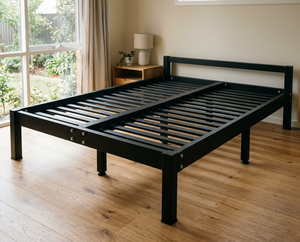
The Double Heavy-Duty Steel Bed Frame Base is listed with a 350 kg capacity. It uses full-steel construction with a black powder-coated finish and is designed for a 137 x 187 cm Australian double mattress. Its specifications include 25 x 50 x 1 mm side rails and legs, a 30 x 30 x 1 mm crossbar and 13 x 16 mm steel supports.
That model suits a shopper prioritising a plainly specified steel foundation and a compact double format. Its 143 x 193 x 29 cm assembled footprint should still be measured against the complete room rather than inferred from the mattress dimensions.
The Queen Metal Bed Base with Slats uses galvanised steel construction, a powder-coated finish and flexible wooden slats. It measures 153 x 203 x 30 cm, matches a standard Australian queen mattress of the same width and length and has an approximate stated capacity of 300 kg.
Its 30 x 40 x 1 mm crossbar and 30 x 30 x 1.2 mm side rails create a different structural configuration from the full-steel double. The comparison shows why shoppers should not use size, material or capacity as the sole deciding factor.
Choose the Configuration Around the User and Room
The most suitable strong bed frame depends on what the bedroom needs to do beyond holding a mattress.
Main Bedrooms and Shared Beds
For two sleepers, calculate the combined load and allow for the mattress. A queen or king may provide the desired sleeping width, but it must also preserve access to wardrobes and both sides of the bed.
Check whether the bed will be used for sitting upright, reading or watching television. A platform base without a headboard may need to be paired with a separate bedhead, while an upholstered frame may provide a softer backrest but require more cleaning.
Guest Rooms and Flexible Spaces
A guest bed needs to suit the range of people likely to use it rather than one known sleeper. A clearly stated capacity and straightforward mattress match can make selection easier.
Flat-packed, dismantlable designs may also suit rooms that change function. However, repeated disassembly requires careful management of bolts, brackets and instructions so the frame can be rebuilt correctly.
Rental Bedrooms and Frequent Moves
A simple steel base can be practical where the bed may need to move between rooms or homes. Before buying, consider the packaged component lengths, staircase turns and doorway widths.
Do not assume flat-packed means every component is short. Long side rails can still be difficult to manoeuvre through a tight hall even when the complete bed has not been assembled.
Storage-Focused Bedrooms
A raised base can create accessible space for containers, but centre legs and crossbars may divide that area. Measure each usable opening rather than calculating one large rectangle beneath the mattress.
Storage should never interfere with the frame’s supports. Containers must fit around the legs instead of pressing against or displacing them.
Avoid Common Heavy-Duty Bed Frame Buying Mistakes
The first mistake is treating “heavy-duty” as a measurable specification. It is a useful product description only when supported by an actual capacity and construction details.
The second is comparing capacity without including the mattress. A substantial mattress can account for an important part of the total load.
The third is assuming that a king frame must support more than a queen or double. Ratings are specific to individual designs.
Another error is checking the mattress label but not its dimensions. An older mattress or a product made for a different market may not match the measurements expected by the new frame.
Buyers also overlook the floor. A strong structure can still feel unstable if its legs do not sit evenly or if part of the base rests on a thick rug while other supports contact the hard floor.
Finally, do not ignore assembly access. Leave enough room around the frame to align the rails, reach the fasteners and inspect the central supports before the mattress is placed on top.
Complete This Final Check Before Ordering
Write down the following information for every shortlisted bed:
- Exact mattress width, length, depth and weight
- Combined weight normally placed on the frame
- Published product capacity and whether it is described as approximate or static
- Internal mattress area
- Complete assembled width, length and height
- Support type, including slats, rails, crossbars and centre legs
- Usable clearance below the frame
- Space needed to assemble and periodically access the connections
- Narrowest doorway, hallway turn or staircase on the delivery route
- Any missing specification that needs confirmation
Then compare the products using those notes, not their names or appearance. This reveals whether a higher capacity solves your actual requirement or simply distracts from a poor mattress match, unsuitable height or difficult room footprint.
Once the frame is assembled and before the mattress goes on, photograph the central supports, leg positions and main fastener locations. Keep those images with the instructions and label any supplied spare hardware with the product name. That small record gives you a clear reference when moving the bed or inspecting connections that will become hidden beneath the mattress.
Frequently Asked Questions
How much weight should a heavy-duty bed frame hold?
There is no single capacity that defines every heavy-duty bed frame. Calculate the combined weight of the mattress, sleepers and anything else regularly placed on the bed, then compare that total with the exact product rating. Leave practical headroom rather than selecting a frame whose limit only just matches your calculation. Confirm how the capacity is described if the listing does not explain what it includes.
Does a bed frame weight limit include the mattress?
It may, but this should not be assumed unless the product information makes it clear. The frame carries the mattress as well as the people using it, so mattress weight belongs in your load calculation. If the listing gives only one capacity figure without defining the test conditions or inclusions, seek clarification before deciding how much of that figure is available for sleepers.
Is a metal bed frame better for higher weight capacity?
Metal can provide a strong, clearly specified structure, but material alone does not determine capacity. Examine the rails, crossbars, slats or steel supports, centre legs and connections, then check the published rating for that model. A well-designed steel frame may suit higher-load requirements, while another metal design may have a lower limit because its dimensions and support arrangement are different.
Can two people use a bed frame with a 300 kg capacity?
That depends on the combined weight of both people, the mattress and any additional regular load. A 300 kg listing should not automatically be divided between two sleepers without including the mattress. Check whether the rating is approximate or described as static, and allow headroom below the stated maximum. Mattress compatibility and correct assembly remain necessary even when the calculated total is within the figure.
Do more support legs mean a stronger bed frame?
Not necessarily. Support legs are useful only when they are correctly positioned, firmly connected and in full contact with a level floor. Their relationship to the centre rail and crossbars matters more than the number alone. Compare the complete support layout and published capacity rather than counting legs from a product image. Correct assembly is also essential for the structure to distribute weight as intended.
What should I do if a bed frame has no published weight capacity?
Treat the capacity as unconfirmed rather than estimating it from the material, size or appearance. Ask for the product-specific figure and clarify whether the mattress is included in that rating. In the meantime, compare only the available dimensions, support design and mattress compatibility. If load capacity is a key purchasing requirement, prioritise frames with clear specifications over products that rely solely on terms such as sturdy or reinforced.
Related Articles
-
 Tags:
Bed Frames