1300 760 441
 cs@factoryfast.com.au
Medicine Balls vs Slam Balls: Choose the Right Weight, Bounce and Grip
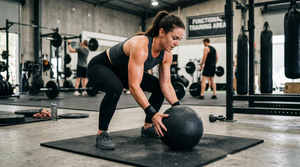

Drop the wrong weighted ball onto the floor and its behaviour tells you the buying mistake immediately.
A medicine ball intended for throws or controlled drills may rebound, while a purpose-built slam ball is designed to absorb impact and stay down. That difference changes the exercise, the required space and the way the user retrieves the ball for the next repetition.
This medicine and slam balls buyer guide compares those designs by movement, bounce, load, grip and training environment.
Factory Fast’s medicine and slam balls range currently emphasises durable no-bounce options, so the live product examples below are slam-style balls.
When considering a traditional rebounding medicine ball, confirm the individual listing rather than assuming every weighted exercise ball behaves the same way.
The Core Difference Is What Happens After Release
Both products place resistance inside a ball-shaped object, but their intended movement patterns differ. Start with the verb in the exercise: slam, throw, catch, carry, rotate or press.
Medicine balls support controlled throws and multi-directional drills
Medicine balls are commonly used for controlled partner passes, rotational work, carries, presses and exercises where the ball is caught or redirected.
Depending on its construction, a model may offer some rebound. That can be useful when the exercise expects a return path, but it requires clear space and a user who can manage the ball’s movement.
The name alone is not a performance specification. Some listings use medicine ball broadly for several weighted ball types. Check the product description for bounce behaviour, shell material, intended exercises and whether repeated floor impact is supported.
Slam balls are made to absorb forceful floor impact
A slam ball is usually sand-filled or otherwise designed to minimise bounce. The user lifts or raises it, drives it towards the floor, then bends to retrieve it.
Because it does not spring back into the hands, each repetition includes the return to the floor and the lift from a low position.
No-bounce behaviour is valuable for power and conditioning circuits, but it does not make every surface suitable. The product needs a clear contact area, and the surrounding floor, walls and nearby equipment must be considered.
Wall balls form a neighbouring category
Wall balls are often larger and designed for repeated throws to a target, with a controlled return for catching. Their construction and seams may differ from a dense slam ball.
A wall ball should not be substituted for repeated floor slams unless its listing supports that use. Likewise, a dead-bounce slam ball may feel awkward for a drill that relies on predictable rebound.
Choose the Ball by Exercise
“Core training” and “full-body workout” are too broad to decide between products. Translate the goal into actual movements and note whether the ball leaves the hands.
Choose a slam ball for repeated floor slams
The defining pattern is lift, accelerate, impact, retrieve and repeat.
A no-bounce design keeps the ball near the contact point instead of sending it across the room. It suits solo circuits where the user controls the full movement and does not need a partner to return the ball.
Wood-chop patterns, shouldered carries and controlled ground-to-shoulder movements may also suit certain slam balls, provided the grip and load are manageable.
Choose a medicine ball for catching and rotation
If the plan includes partner passes, chest throws, rotational tosses or a ball that returns from a wall, a medicine-ball design with stated rebound characteristics may be more appropriate.
The ball should be light enough to catch without losing hand position or torso control.
For seated rotations, carries and presses where the ball stays in the hands, grip and size may matter more than bounce. Compare the weighted ball with a dumbbell or kettlebell as well; the best tool is the one whose shape supports the intended path.
Choose a static weight when release is not part of the exercise
If every planned movement keeps the object in the hands and relies on a stable handle, a weighted ball may add complexity without useful function.
Browse the gym weights collection and gym weights buyer guide to compare balls with free weights that offer defined grips and easier fine loading.
Select a Weight You Can Accelerate and Control
Weighted-ball selection is not the same as choosing a dumbbell for a slow curl. Dynamic exercises require the user to accelerate, decelerate or catch the object.
A mass that can be lifted once may be too heavy for repeated slams or accurate throws.
Start with movement quality
Practise the pattern with a lighter object or no external load. Note the intended range, foot position and torso control.
The selected ball should allow the same movement without turning a coordinated action into a slow heave.
For slams, the user should be able to raise the ball to the planned height, direct it to a consistent contact point and retrieve it with a controlled hinge or squat.
For catches and partner work, choose more conservatively. The receiving phase adds a demand that a dead-bounce floor slam does not. If the ball cannot be caught in the intended position, reduce the mass or change the drill.
Use lighter and heavier balls for different jobs
A lighter weighted ball can suit faster, more accurate movements and longer circuits. A heavier option can suit slower strength-focused carries or lower-repetition slams where the user retains control.
The live 7 kg no-bounce slam ball is specified with a sand fill and high-density latex cover.
It provides a middle-weight reference for shoppers who have already tested the movement pattern. Factory Fast does not list a metric diameter on the live page, so buyers who need a specific hand span or storage fit should confirm size rather than infer it.
Do not choose the heaviest option as proof of future value
A ball that is too heavy for the current movement is not automatically a good progression tool. Unlike removable plates, its mass cannot be reduced.
Select the first ball for present control, then add a heavier step only when the exercise remains crisp. A useful lighter ball remains relevant for warm-ups, faster circuits and other household users.
Compare Bounce, Filling and Shell Construction
The outer surface and internal filling determine how a ball feels in the hands and behaves at impact. Product names can overlap, so specifications should carry more weight than labels.
No-bounce filling changes the rhythm
Sand-filled slam balls absorb much of the impact and settle near the landing point. This creates a work cycle that includes bending to retrieve the ball.
Some slam balls may shift slightly as the filling settles. That changing centre of mass can be part of the training feel, but it also means the ball should be controlled rather than swung casually near other equipment.
If a consistent rebound is required, a dead-bounce design is the wrong tool.
Shell construction should match documented use
Latex and rubber-style shells are common in impact-oriented balls. Look for construction language that explicitly supports the intended movement.
Seams, valve areas and textured panels are potential wear points, so the ball should be inspected as part of routine gym upkeep.
The live 10 kg tyre-tread slam ball is specified as a non-bounce design with a textured tyre-style surface.
That texture is intended to improve grip during movements such as wood chops and overhead throws. It is a different buying proposition from a smooth ball chosen mainly for controlled two-hand carries.
Grip and Ball Size Matter More as Weight Rises
Two balls with the same mass can feel different if one is larger, smoother or harder to wrap the hands around.
Grip should be evaluated for the smallest hands likely to use the equipment, particularly in shared home gyms.
Texture can help, but technique still matters
A raised tread or textured shell can make it easier to maintain contact when hands become damp.
Deep texture may feel more aggressive during high-volume catches or carries. For a slam ball, the ideal surface lets the user guide the ball without squeezing so hard that the forearms become the limiting factor.
Wipe the shell between users and let it dry after a humid session. Dust and residue can change the surface feel, so maintenance is part of grip performance.
Diameter affects reach, storage and exercise selection
A larger diameter can suit two-handed throws but may be harder to control for users with a shorter reach.
A compact dense ball is easier to store, yet it concentrates the load into a smaller object. Check metric dimensions wherever supplied. When a page omits a metric diameter, treat size as unresolved rather than estimating from the product image.
For storage, measure shelf depth and clearance between rack levels. A ball should sit without being wedged behind plates or placed where it can roll into the lifting area.
Check the Training Space Before Adding Dynamic Movement
Weighted ball exercises use more three-dimensional space than many static lifts. The user may raise the ball overhead, rotate through the torso or release it towards a floor or wall.
Map the complete path of the ball
Trace the full movement from the intended position. Check ceiling height, fittings, shelving, windows and nearby equipment, allowing for an imperfect release.
Partner drills need clear receiving space. Wall throws require a suitable ball and contact surface. Keep floor-slam products within their documented use.
Consider floor contact and noise
A no-bounce ball still transfers force into the surface. Concrete, timber and layered gym flooring respond differently.
Keep the contact zone clear of seams, loose mats and small objects. If the room shares walls or floors with living areas, consider how repeated impacts will sound before choosing a high-volume slam routine.
Decide Whether You Need One Ball or a Small Set
One well-chosen ball can cover several exercises when its weight and construction suit them all.
Add a second only for a distinct role, such as lighter controlled throws versus heavier no-bounce floor work, or when multiple users need different loads.
Label storage positions by mass before anyone begins a dynamic movement.
Medicine and Slam Ball Buying Mistakes to Avoid
The largest mistake is assuming medicine balls, slam balls and wall balls are interchangeable. Confirm bounce behaviour and intended impact before purchase.
Another error is choosing weight from a slow lift rather than the dynamic exercise. A user may be able to hold 10 kg securely but not accelerate, catch or retrieve it with the required control.
Do not ignore product quantity and metric size information. Listings usually supply one ball unless stated otherwise, and images do not provide reliable scale.
Finally, avoid using surface texture as the sole durability cue. Grip pattern, shell material, filling and documented use all need to agree with the planned exercise.
A Comparison Checklist for the Final Choice
- Write the primary movement as a verb: slam, throw, catch, carry, rotate or press.
- Decide whether the ball should rebound, return predictably or stay near the impact point.
- Choose a mass that preserves speed, accuracy and control.
- Check shell material, filling, texture, metric diameter and stated exercise suitability.
- Map the full movement path through the room, including an imperfect release.
- Confirm the storage position and cleaning routine.
- Add another weight only when it has a clearly different training role.
Complete one sentence before checkout: “Most sessions will use this ball for…” If the final verb is slam, prioritise documented no-bounce impact use. If it is catch or rebound, keep searching until the listing explicitly supports that behaviour. That sentence is a sharper filter than the category name on its own.
Frequently Asked Questions
-
 Tags:
Medicine and Slam Balls
Tags:
Medicine and Slam Balls