1300 760 441
 cs@factoryfast.com.au
Boxing Pads and Shields Buyer Guide: Focus Mitts, Kick Pads and Strike Shields Compared
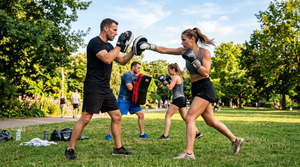

The wrong training target can make a good session unnecessarily awkward. Small mitts reward accurate punches but offer limited coverage. Larger kickboxing pads accept a broader range of strikes, while a full strike shield gives the holder a substantial target for power-focused drills.
Choosing between boxing pads and shields therefore starts with the movements you intend to practise, not simply the thickest pad or largest target. Target area, padding depth, grip position, outer material, partner experience and available storage all affect which format will work best.
The Short Answer: Which Boxing Pad Should You Choose?
Choose focus mitts when the main goal is punch accuracy, speed, combinations and moving-target drills. Their compact face makes the striker place each jab, cross, hook or uppercut deliberately. They also allow the holder to change target height and angle quickly.
Choose kickboxing or Thai-style pads when sessions combine punches with kicks, knees or other controlled striking drills. Their longer face and forearm-mounted grip arrangement provide more coverage than focus mitts without becoming as large as a body shield.
Choose a strike shield when you need a broad target for power practice, conditioning drills or participants who are still developing accuracy. A large shield is easier to locate during movement, although it is less suitable for quick left-right punch combinations.
A mixed set is useful when two people want to alternate between precision boxing drills and broader kicking work. It can also be the more economical starting point when a home setup needs both small and large targets.
Compare Focus Mitts, Kick Pads and Strike Shields
Focus mitts are built for precision and speed
Focus mitts are small handheld targets used mainly for punch combinations, reaction drills and footwork. The holder can present one mitt at a time, create left-right sequences or move the targets to encourage the striker to adjust distance and angle.
Compact dimensions are an advantage when accuracy is the objective. A current pair of PVC boxing focus mitts measures approximately 25 x 20 x 5 cm per mitt. Finger slots and elastic straps help the holder maintain their position while moving between targets.
That size suits jabs, crosses, hooks and uppercuts. It is less suitable for powerful kicks because the target area is small and the retention system is designed around the hand rather than the forearm. Buyers who primarily train boxing-style combinations will usually get more practical use from focus pads than from a large shield.
Kick pads balance target coverage with mobility
Kickboxing pads sit between compact mitts and full-size shields. They provide a longer striking face while remaining manageable enough for a holder to position on the forearms. This makes them suitable for mixed punch-and-kick sessions where the target must move between head, body and leg height.
The verified leather kickboxing pad pair measures 37 x 19 x 8 cm per pad. Each one combines gel and foam padding with reinforced stitching, two adjustable straps and a stationary strap. The listed adjustable strap lengths are 34 cm and 42 cm.
Those dimensions give the striker a larger target than a focus mitt while preserving the ability to work left-right combinations. The extra depth is also relevant when kicks form part of the session. Check whether the listing supplies one pad or a pair, because many drills assume the holder can present targets on both sides.
Strike shields create the broadest target
A strike shield is designed to be held against or in front of the body using rear handles. It provides a large target for kicks, straight punches and conditioning exercises. The holder generally moves the entire shield rather than presenting two independent targets.
A verified curved boxing strike shield measures approximately 70 x 40 x 16 cm. It uses a 1200D ripstop vinyl cover, canvas-backed sides, medium-density foam, double-tubed handles and two air-release eyelets.
The 70 x 40 cm face gives the striker considerably more room than a mitt or forearm pad. This can help when practising body-height kicks, driving combinations or drills where making clean contact matters more than selecting a very small target. The tradeoff is reduced left-right target movement and a larger storage footprint.
Why Target Size and Padding Depth Matter
Target size changes the skill being tested. A large shield can help a beginner establish distance and complete a controlled movement. A small mitt asks for more precise placement. Neither is automatically more advanced; each creates a different training constraint.
A common mistake is buying the largest target available and expecting it to cover every session. Large shields can be effective for power and conditioning work, but they do not reproduce the quick visual decisions created by two independently moving mitts. Conversely, a compact focus pad can be ideal for fast combinations while being poorly matched to heavy kicking drills.
Padding depth also needs to be judged in context. The reviewed focus mitts are approximately 5 cm deep, the leather forearm pads are 8 cm deep, and the larger shield examples are around 15 to 16 cm deep. These measurements should not be read as a simple quality ranking. They reflect different target formats, strike types and holding positions.
Consider how the padding is distributed as well as its stated depth. A curved surface may help the holder present a defined centre, while a broad flat or gently curved shield creates more room for body-height contact. Product dimensions should always be checked against the exact drill rather than compared in isolation.
Check the Holder’s Grip Before the Striker’s Features
The holder experiences every repetition, so grip design is a buying factor rather than a minor accessory detail. Poorly matched straps can make the target rotate, move away from the intended angle or require frequent readjustment.
Hand-mounted mitts need secure retention
Focus mitts commonly use finger channels, a rear hand pocket or elastic retention straps. The holder should be able to insert the hand comfortably and keep the pad aligned without clenching continuously. A target that feels secure with one user may fit another person differently, particularly when hand sizes vary.
For a shared household, look at the rear design rather than assuming a one-size fit. Elastic systems are simple and quick to use, while more adjustable closures may offer greater control across several holders.
Forearm pads need multiple contact points
Kick pads place more of the target along the forearm. Adjustable straps allow the user to change the fit, while a fixed handle or stationary strap gives the hand a consistent gripping point. This arrangement helps the holder control the pad’s angle during punch-and-kick sequences.
When comparing listings, identify how many straps are provided, where they sit and whether adjustment measurements are supplied. A pad should suit the holder’s arm position without forcing the wrist into an awkward angle.
Shields need handles that suit the planned orientation
Large shields may be held vertically, horizontally or at an angle depending on the exercise. Multiple rear handles give the holder more positioning choices. Reinforced or padded grip bars can also make it easier to maintain a stable hold during repeated drills.
Look at handle placement in relation to the shield’s size. A large face is only useful if the holder can control it at the required height without obscuring their view or crowding their stance.
Compare Cover Materials and Construction
Outer material affects feel, cleaning and how the pad handles repeated use. The Factory Fast examples in this category use PVC, PU, leather and heavy-duty ripstop vinyl, each paired with padding suited to a particular format.
PVC works well for compact focus mitts because it creates a wipeable surface at an accessible price point. Inspect the areas around finger slots, elastic straps and seams, as these parts experience repeated handling whenever the targets are moved.
PU is another practical covering for home and gym training equipment. In a large shield, it can be paired with high-density foam and padded grip bars to create a versatile target without the structure of a fixed punching bag.
Leather suits buyers who want a traditional outer material on forearm-mounted pads. Construction still matters alongside the material name. Reinforced stitching, secure strap attachment and a consistent padded surface are important because these are the areas repeatedly loaded during partner drills.
Ripstop vinyl is suited to larger equipment where a robust, wipeable covering is useful. The verified curved shield also uses canvas-backed side panels, industrial-quality webbing and air-release eyelets. Those eyelets allow displaced air to leave the pad as the foam compresses.
Do not choose by cover material alone. First determine the correct target type, then compare construction within that format.
Match the Equipment to Your Training Style
Boxing combinations and reaction drills
For boxing-focused sessions, begin with a pair of mitts. Two independent targets allow the holder to call combinations, change height and create movement. They are particularly useful when timing, accuracy and punch selection matter more than maximum impact.
A hanging or freestanding bag can complement this work, but it does not replace the feedback of a partner presenting targets. Mitts make the session interactive because the holder can change the sequence in response to the striker.
Kickboxing and mixed striking practice
Forearm pads suit sessions that include both hand and leg techniques. Their elongated shape accepts punches while giving more room for controlled kicks. A pair also lets the holder establish alternating targets, which is difficult with one large shield.
Check that the target dimensions are suitable for the experience of both participants. A narrow pad demands greater accuracy, while a longer face gives more usable room without removing the holder’s ability to move.
Power and conditioning sessions
A broad kick shield is the more natural fit when the drill centres on repeated body-height contact or a larger target. Its size can also make partner sessions easier to organise when participants are still learning how to judge distance.
Pad training can form one part of a broader conditioning setup. Shoppers combining striking sessions with resistance work can use the gym weights buyer guide to plan complementary equipment around load progression, available room and storage.
Households that want more than one drill type
A combined set reduces the need to choose one target format immediately. The current shield and focus mitt training set includes a 66 x 30 x 15 cm PU and high-density foam shield plus two 25 x 20 x 5 cm PVC mitts.
That combination suits households that want a broad kicking target and compact punching targets without assembling two separate purchases. It also makes the difference between the formats obvious during training: use the shield for coverage, then switch to the mitts when accuracy becomes the priority.
Plan a Practical Home Training Area
Boxing pads are portable, but partner work still requires enough usable room for two people to move. Measure the clear training zone rather than the storage space alone. The striker needs room to establish distance, while the holder needs space to step, turn and reposition the target.
Remove loose furnishings and overhead obstructions from the active area. Flooring should provide a stable surface for both participants. If the room must return to another use after training, decide where the pads will dry and where they will be stored before buying.
Compact mitts fit easily into a cupboard or equipment tub. Forearm pads require more volume because they are longer and commonly sold as a pair. A 70 x 40 x 16 cm shield needs a defined storage position so it is not compressed under heavier equipment.
The broader home fitness equipment range can help when planning an Australian home gym around several activities. Keep partner striking equipment accessible rather than burying it behind benches or weights; equipment that takes too long to retrieve is less likely to become part of a regular session.
Noise is another practical consideration in a shared home. Pad work does not require permanent mounting, but foot movement and repeated contact can still travel through floors and adjoining rooms. Choose a training time and location that suit the household.
Avoid These Common Buying Mistakes
The first mistake is choosing by appearance rather than strike type. A compact mitt, forearm pad and body shield may all be described as boxing training equipment, but they are not interchangeable.
The second is failing to check quantity. Product listings may include one shield, one pair of pads or a shield-and-mitt set. Confirm every inclusion before comparing value.
The third is overlooking the holder. The striker may prefer a substantial target, but the equipment still has to fit the person presenting it. Review hand pockets, strap adjustment, handle location and the total size of the pad.
The fourth is assuming more padding automatically means a better product. Depth must match the pad’s size and intended use. A 5 cm focus mitt and a 16 cm shield solve different training problems.
The fifth is buying for a future routine rather than a current one. If nearly every planned session involves punches, begin with mitts. If kicks are central, prioritise forearm pads or a shield. A more specialised first purchase is often more useful than equipment chosen to cover unlikely exercises.
Finally, do not ignore care and storage. Damp equipment placed immediately into a sealed container can develop odour and surface deterioration. A wipe-down and ventilated drying position should be part of the setup from the first session.
Set a Realistic Budget for the Target Format
At the time of review, the verified Factory Fast examples used for this guide ranged from $29.95 for a pair of compact focus mitts to $99.95 for a combined shield-and-mitt set. The leather forearm pad pair and large ripstop-vinyl shield sat between those points.
Compare price only after matching the format to the drill. A lower-priced pair of mitts can be the better-value purchase for boxing combinations because a large shield would not perform the same role. Equally, buying compact targets for kick-focused sessions can lead to another purchase soon afterwards.
For a first setup, buy the target that supports the session you expect to repeat every week. Add a second format once your training changes enough to justify it.
Final Boxing Pad Buying Checklist
Before ordering, confirm:
- whether your sessions focus on punches, kicks or mixed combinations
- whether you need two moving targets or one broad striking surface
- the listed length, width and padding depth
- whether the product contains one pad, a pair or a combined set
- how the holder grips or straps on the target
- whether the fit can adjust between different users
- the cover material and cleaning guidance
- the space needed for movement, drying and storage
For the most revealing final check, write down the first three drills you plan to perform and assign a target to each one. If the same product cannot support at least two of those drills well, choose a more suitable format or a mixed set before committing.
Frequently Asked Questions
-
 Tags:
Boxing Pads and Shields
Tags:
Boxing Pads and Shields