1300 760 441
 cs@factoryfast.com.au
Staff Lockers Buyer Guide: How to Choose Secure Workplace Storage

Staff lockers solve a problem that shows up quickly in shared workplaces: bags under desks, uniforms left in change areas, personal items moving between shifts, and no clear place for staff to keep what they need during the day. The right locker setup gives each person a defined storage space without turning the workplace into a storage room.
For Australian businesses, the best choice depends on who will use the lockers, what they need to store, how often the compartments change hands, and how much floor space you can give to the system. Factory Fast’s staff lockers range includes metal locker options for offices, gyms, schools and commercial spaces, so the buying decision starts with matching the layout to real staff routines.
Start With How Staff Will Use The Lockers
A locker used by one employee every day has different requirements from a locker used by rotating shift workers, visitors or contractors. Before comparing finishes and lock types, decide whether the storage is personal, shared, temporary or role-based.
For Assigned Staff Storage
Assigned staff storage works best when employees need a consistent place for bags, lunch containers, uniforms, documents or small personal items. In this setting, a key lock can be practical because the user keeps one key while the business keeps the spare in a controlled place.
The 6-door black metal locker cabinet suits compact workplace storage because it measures 1800 x 380 x 450mm and provides six compartments in a narrow footprint. Each inner compartment is listed at 291 x 380 x 450mm, giving staff a useful personal space without taking over a full wall.
For Shared Or Rotating Users
Where lockers are used by different people across shifts, combination locks can reduce key handling. They are useful for teams that need flexible access, especially where the same compartment might be used by different people on different days.
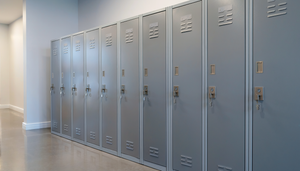
For higher user numbers, the 12-door grey locker with standard locks gives twelve lockable compartments, each with a 30kg capacity. The overall dimensions are listed as 180 x 90 x 36cm, making it better suited to wider staff areas than narrow office corridors.
Choose The Right Compartment Count
The simplest mistake is buying by total height rather than user count. A tall locker does not automatically solve the storage problem if the compartments do not match what staff actually carry.
Four To Six Compartments For Smaller Teams
A four-door or six-door layout suits smaller teams, staff rooms and back-of-house spaces where people need room for bags, folded clothing or work items. These layouts give each user more vertical or square storage space, which can be more useful than a very small compartment if staff bring bulkier items.
Six-door units are a balanced choice when you need multiple personal spaces but still want the locker to fit along a modest wall. The Factory Fast six-door metal options also include ventilated doors, label holders and powder-coated finishes, which help with daily identification and upkeep.
Twelve Compartments For Higher Turnover
A twelve-door locker works when the priority is serving more users in the same general zone. It is useful for workplaces with casual staff, shift changeovers, visitor belongings or small-item storage.
The tradeoff is compartment size. A twelve-door model can be efficient for personal items and smaller bags, but less suitable for bulky uniforms, boots or larger work equipment. If staff need to store larger gear, fewer and taller compartments may be the better fit.
Compare Lock Types Before You Compare Colours
Lock choice affects everyday management. It is not just a security detail; it changes how much admin the business has to handle.
Standard Key Locks
Standard locks with two keys are straightforward for assigned users. They are easy to explain, simple to operate and useful where a manager needs a spare key process. They suit workplaces where the same person uses the same locker regularly.
The downside is key management. If staff turnover is high, or if lockers are used casually, a key-based system can create more replacement and handover work.
Combination Locks
Combination locks suit shared environments where users may change often. Factory Fast product pages list 3-digit and 4-digit combination lock options across locker variants, with some product listings also noting a master key arrangement for access support.
This option is useful when the business wants fewer loose keys in circulation. It works best when there is a clear internal process for resetting, assigning or recording locker access.
Padlock-Operated Options
Padlock-operated lockers can suit workplaces where staff bring their own lock or where the business wants a simple, replaceable lock approach. This can be practical for temporary users, but it may look less uniform in customer-facing or polished office settings.
Match Materials And Finish To Daily Wear
Most Factory Fast locker examples in this range use cold-rolled steel with a powder-coated finish. That matters because staff lockers often sit in high-use areas: change rooms, office corridors, back rooms, workshops or shared storage zones.
A powder-coated metal surface is a practical choice when the locker needs to be easy to wipe down and resistant to everyday marks. Black and grey finishes are especially useful in workplace settings because they look professional without drawing too much attention.
Plan The Footprint Before Ordering
Measure the wall, not just the product. A locker needs clearance in front so doors can open and people can stand while using it. It also needs a location that does not block walkways, exits, desks, shelving or staff room appliances.
For narrow spaces, a 380mm wide six-door vertical cabinet may be easier to place than a 900mm wide twelve-door unit. For larger staff zones, wider multi-compartment models can create a clearer storage wall and reduce scattered personal items.
Buying Mistakes To Avoid
Do not choose purely by the number of doors. A higher compartment count may look efficient, but it can be the wrong choice if staff need to store shoes, jackets, equipment or larger bags.
Do not ignore access management. If the business has no appetite for spare-key handling, combination locks may be more practical. If staff are assigned a permanent locker, key locks may be simpler.
Do not place lockers after the rest of the room is already full. Staff storage works best when it is planned as part of the workflow: where people enter, change, start a shift, take a break or leave for the day.
The most useful final check is to picture the busiest handover period in the workplace. If several people can open doors, place bags inside, collect belongings and move away without blocking one another, the locker layout is far more likely to work after the first week.
Frequently Asked Questions
-
 Tags:
Staff Lockers
Tags:
Staff Lockers