1300 760 441
 cs@factoryfast.com.au
Puzzle Tables and Boards Buyer Guide: Size, Storage and Setup
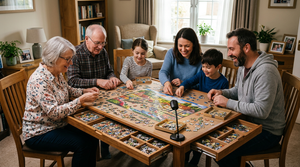

An unfinished jigsaw can occupy the dining table for days, but packing it back into the box means losing every carefully assembled section. The practical solution is a dedicated surface that lets you sort, build, pause and resume without starting over.
The right choice is not simply the model with the highest advertised piece capacity. A useful puzzle workspace must fit the completed jigsaw, suit the way you organise loose pieces and store comfortably when the room is needed for something else. Some puzzlers benefit from a table with folding legs, while others need a portable board, rotating surface or compact felt mat.
This guide explains how to compare puzzle tables and boards by usable area, format, surface material, storage and everyday setup.
What Is the Difference Between a Puzzle Table and a Puzzle Board?
A puzzle table is a self-supporting workstation. It has legs or a base that allows it to be used without placing the board on another piece of furniture. Depending on the design, the legs may fold away so the unit can be stored against a wall or beneath suitable furniture.
A puzzle board is a rigid or semi-rigid assembly surface designed to sit on a dining table, desk, coffee table or other stable base. It may include raised edges, drawers, a protective cover or a rotating mechanism, but it usually depends on existing furniture for support.
A puzzle organiser combines an assembly surface with a folding cover or carrying format. This type suits homes where a project must be closed, moved and stored between sessions.
A roll-up mat is the most compact option. It uses a flexible felt surface and a tube to preserve the general arrangement of a work in progress. It is easier to store than a rigid board, although it does not provide the same firm base for pressing pieces together.
Choose according to where the puzzle will live
A self-supporting table makes sense when there is a regular puzzle corner but no suitable desk or dining surface. A tabletop board is more efficient when the home already has a strong, level base and the project only needs to be moved occasionally.
If the dining table must be cleared every evening, portability and project protection become more important than a permanent set of legs. In a compact home, the dimensions of the product when stored may matter just as much as the dimensions while in use.
Start With the Finished Puzzle Dimensions
Piece count is a useful starting point, but it does not guarantee that a jigsaw will fit a particular board. Two puzzles with the same number of pieces can have different completed lengths and widths because manufacturers use different piece shapes, cuts and image proportions.
Check the completed dimensions printed on the puzzle box, then compare both measurements with the usable board area. Do not compare the puzzle against the product’s overall external size, because frames, raised edges, drawer housings and handles may reduce the actual building space.
Allow room for assembly, not just the final image
A puzzle that only just fits within the usable area may leave nowhere to place loose pieces while building. Drawers can solve part of this problem, but most people still benefit from a clear strip around the image for temporary groups and sections.
Consider how you work. If you build the border first and sort all other pieces into drawers, a close fit may be manageable. If you prefer to spread every piece face-up around the main image, choose a larger surface or use separate sorting trays.
Check the board against the supporting furniture
A tabletop board needs full, stable support. Measure the dining table, desk or bench where it will sit and consider any rotating base underneath it. Avoid assuming that a wide puzzle board will balance securely on a much narrower surface.
Also measure the route between the work area and the intended storage position. A board may fit beneath a bed but still be awkward to carry through a narrow doorway or around a tight hallway corner. Include the frame thickness and any projecting drawer handles in this check.
Compare the Main Puzzle Workspace Formats
Each format solves a different household problem. The best option depends on whether the project stays in one place, moves between rooms or needs to disappear after every session.
Folding puzzle tables for a dedicated station
A model with legs creates a defined hobby area without requiring a separate desk. This suits regular puzzlers who want to sit down and begin without first moving a board into position.
The foldable 1500-piece puzzle table with drawers has a 67 x 87 cm tabletop, a pine wood structure, four detachable density-board drawers and folding legs. Its leg design allows the workstation to be packed down when the room needs to serve another purpose.
Before choosing a folding design, consider the open footprint, the available knee space and the intended chair position. The surface may fit the puzzle, but the complete setup still needs enough room for the user to sit, reach the drawers and move around the table.
Tabletop boards for existing furniture
A flat board is a practical middle ground between a permanent table and a flexible mat. It creates a contained building surface while making use of furniture already in the home.
Rigid boards are well suited to projects that remain horizontal during storage. They can be moved off a dining table when required, provided there is a suitable place to set them down. Check the board’s weight and external dimensions if one person will move it regularly.
Raised borders help contain loose pieces near the edge. A cover adds another layer of protection when the puzzle remains set up between sessions, although the board should still be kept flat unless its product design specifically supports another storage orientation.
Folding organisers for frequent movement
A folding organiser is designed around portability and project containment. It can suit shared homes, multipurpose rooms and puzzlers who work in different parts of the house.
The foldable 1000-piece jigsaw organiser opens to 165 x 58 x 3 cm and closes to 82 x 58 x 3 cm. It includes two 53 x 39 cm sorting boards and uses 600D Oxford cloth, flannel, sponge and cardboard in its construction. Three nylon fastenings keep the folded format together.
This type is useful when the project needs to be closed after each session. Its main trade-off is that a folding system occupies more space when fully opened than its closed dimensions suggest, so measure the complete working area rather than only the stored footprint.
Roll-up mats for compact storage
A mat is a straightforward choice when cupboard space is limited or puzzle projects are occasional. The flexible format packs down more easily than a timber or particle-board surface.
The 1500-piece roll-up puzzle mat measures 118 x 66 cm and includes a felt surface, three tube sections and two fastening straps. It is designed to be used on a flat, smooth base before being rolled around the assembled tube.
Rolling is better suited to preserving general progress than maintaining the precise alignment of every joined section. Build and store the mat carefully, and expect to make small adjustments after unrolling. For frequent use, a rigid board provides a firmer assembly experience; for occasional projects, the smaller storage footprint may be the stronger benefit.
Decide Whether Rotation Is Worth Prioritising
A rotating puzzle table lets the user bring different parts of the image closer without walking around the workspace or repeatedly shifting the whole board. It can be particularly useful for shared projects because people sitting on different sides can turn the active area towards themselves.
The 1500-piece rotating puzzle board with six drawers has an 89 x 68.5 cm overall footprint and an 87 x 67.5 cm usable area. Its particle-board surface rotates through 360 degrees and includes four large drawers, two smaller drawers and a protective cover.
Rotation adds functionality, but it also changes the setup requirements. The supporting table must accommodate the rotating base, and there must be clearance around the board so the corners do not strike nearby walls, shelves or objects. Check that lamps, drinks and sorting trays will remain outside the rotation path.
Who benefits most from a rotating board?
Rotation is most useful for couples, families and anyone who prefers to work on one section at a time from a close position. It can also help a solo puzzler avoid reaching across a wide image.
It is less important when the board is narrow enough to access comfortably from one seat or when the user already moves around a large table. In those cases, a lighter flat board or folding table may provide better value than a rotating mechanism.
Evaluate Drawers, Sorting Space and Covers
Loose-piece organisation affects how much usable space a puzzle setup really provides. A large board can still feel crowded when hundreds of pieces are spread around the border, while a more compact board with effective drawers may be easier to use.
Drawers let you separate edge pieces, colours, textures and recognisable image sections. Four drawers may be enough for broad grouping. Six smaller zones allow more detailed sorting but also require a consistent system so pieces are not forgotten.
Detachable drawers can be placed beside the user or shared around the table. Integrated drawers remain connected to the board and are less likely to be misplaced, but their position may determine where the board can sit and how it can be carried.
A cover and drawers solve different problems
Drawers manage loose pieces. A cover protects the main work area while the puzzle remains assembled. One feature does not replace the other.
A household with a permanently available hobby room may value sorting space more than a cover. A project left on a shared table is more likely to benefit from both. Before buying, check whether a cover is included, how it sits on the board and where it will be stored while the puzzle is in use.
Choose a Surface That Matches Your Puzzling Style
Surface material affects how easily pieces move. Smooth boards make it simple to slide connected sections into position, while felt provides more grip and helps prevent individual pieces from shifting when the board is moved or placed at a slight angle.
Neither surface is automatically better. The decision depends on whether the user prefers free movement or greater resistance.
Smooth rigid surfaces
A firm surface works well for builders who assemble separate sections and slide them into the main image. It also provides consistent support when pressing interlocking pieces together.
Check for raised edges and the usable space inside them. A surrounding frame helps contain pieces but can make it harder to slide a completed section in from the side.
Felt and lined surfaces
Felt keeps loose pieces steadier and can improve contrast when the puzzle colours differ from the background. Darker felt may make pale pieces easier to see, while it may provide less contrast for puzzles dominated by dark artwork.
More grip means joined sections cannot always be pushed across the surface easily. Users may need to lift a section carefully or build it closer to its final location. This trade-off matters more on large designs where several sections are assembled separately.
Plan for Seating, Reach and Shared Use
A puzzle surface should fit the person as well as the jigsaw. Consider chair height, leg room and the distance from the seated position to the far edge of the board. A generous surface loses much of its value if the central area is uncomfortable to reach.
Place the board so its long edge or short edge faces the user according to the puzzle orientation. A landscape image may be easier to work on with the long side facing the chair, while a portrait layout may require more reach.
For family sessions, provide access from at least two sides rather than pushing the table tightly against a wall. Keep sorting drawers clear of chair arms and knees. Families combining jigsaws with other board games and puzzles should also consider whether the surface can support different activities after the current project is finished.
Match the setup to the main user
For a child, the board must sit at a reachable height and leave enough room for sorting pieces without crowding the image. Adults working on longer projects may prefer a larger surface, supportive seating and a layout that limits repeated reaching.
A shared household may need a compromise: a portable format that can be positioned at different heights rather than a fixed station designed for one person. Browse the wider games and toys collection when planning a multipurpose family activity area rather than buying for one type of play in isolation.
Think Through Storage Before Choosing the Largest Option
A larger surface provides more assembly room, but it also creates a larger storage problem. Identify the storage location before selecting the board.
Measure the clearance beneath the bed, sofa or cabinet rather than assuming a flat product will fit. Include skirting boards, bed supports and low crossbars that may obstruct the opening. If the board will stand in a cupboard, confirm that its design allows that orientation without disturbing the project.
A folding table needs somewhere to rest once its legs are collapsed. A rigid board requires a broad, protected space. An organiser reduces its footprint by folding, while a mat packs into a tube but may need minor realignment when reopened.
Weight also matters when a board will be moved frequently. A feature-rich surface with multiple drawers may be easy to use once positioned but less convenient to carry between rooms. Choose according to the full routine: setting up, puzzling, pausing, moving and reopening.
Match the Product to Your Puzzling Routine
The most suitable format becomes clearer when the decision starts with behaviour rather than features.
For occasional 500-piece and 1000-piece projects
Choose a portable board, compact organiser or felt mat that can be stored without claiming a permanent room. Prioritise manageable dimensions and simple project protection over a large number of drawers.
For regular 1000-piece and 1500-piece projects
A rigid board with drawers provides a more organised workspace. Compare the finished dimensions of the jigsaws you already own with the listed usable area, then allow space for the way you sort.
For shared family projects
Look for rotation, access from several sides and multiple sorting zones. A cover is useful when the project must remain untouched between family sessions.
For a dedicated hobby corner
A table with folding legs offers an independent workstation. Even if it normally stays assembled, the folding format gives the room more flexibility when extra floor space is needed.
For homes with very limited storage
A roll-up mat or folding organiser is more practical than a wide rigid board. Focus on the packed dimensions, the available cupboard space and how often the project will be opened and closed.
Common Puzzle Table Buying Mistakes
The first mistake is choosing by piece count alone. Always check the actual completed puzzle size and the usable working area.
The second is measuring the product but not the room around it. Drawers need space to open, rotating boards need corner clearance, and chairs need room to move.
The third is overlooking the supporting surface. A tabletop board should sit securely on a stable base rather than overhang excessively.
The fourth is buying more portability than the routine requires. A permanent hobby station may benefit more from a rigid surface and generous sorting capacity than from a light carrying format.
The fifth is assuming that every cover permits vertical storage. Unless the product description specifically supports that use, keep an unfinished puzzle horizontal when moving or storing it.
Before ordering, mark the product’s full dimensions on the intended table or floor using removable tape. Sit in the planned chair, reach towards each corner, allow space for every drawer to open and then trace the route to storage. This short rehearsal reveals whether the puzzle table will work through an entire session, not merely whether it fits the puzzle.
Frequently Asked Questions
What size puzzle board do I need for a 1000-piece puzzle?
Check the completed puzzle dimensions on its box and compare them with the board’s usable area. Piece count alone is not reliable because jigsaws with the same count can have different proportions. Allow additional room for temporary sections or choose a design with drawers so loose pieces do not occupy the main building surface.
Is a puzzle table better than a puzzle board?
A puzzle table is better when you need a self-supporting, dedicated workstation. A puzzle board suits homes that already have a stable table or desk and need a project surface that can be moved. The better choice depends on available floor space, supporting furniture, storage location and how often the puzzle must be cleared away.
Can I store an unfinished puzzle board vertically?
Only store a work in progress vertically when the product is specifically designed to secure the pieces in that orientation. A loose cover may protect the top without holding every section in place. Otherwise, keep the board flat and level during movement and storage. A folding organiser or roll-up mat may be more suitable when horizontal storage is unavailable.
Are puzzle table drawers worth having?
Drawers are valuable when you sort pieces by edge, colour, pattern or image section. They free space around the main puzzle and let sorted groups remain organised between sessions. Occasional puzzlers working on smaller designs may manage with separate trays, while frequent or shared projects generally benefit from four or more dedicated sorting areas.
When is a rotating puzzle table useful?
A rotating surface is useful when several people share a puzzle or when the board is too wide to reach comfortably from one position. It brings different image sections closer without moving the entire setup. Allow enough clearance for the corners to turn freely and make sure the supporting table is broad and stable enough for the rotating base.
How should I protect a puzzle table between sessions?
Use the supplied cover when one is included, close sorting drawers and keep the setup on a dry, level surface. Clear drinks, food and unrelated items before covering the project. For a folding organiser, secure every fastening before moving it. With a roll-up mat, wrap the surface evenly around the tube and apply the straps without crushing joined sections.
-
 Tags:
Puzzle Tables and Boards
Tags:
Puzzle Tables and Boards