1300 760 441
 cs@factoryfast.com.au
Wine Racks Buyer Guide: How to Choose the Right Bottle Storage
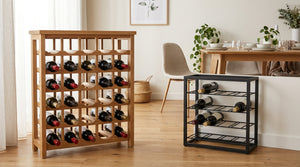

A wine rack needs to do more than hold the number of bottles on its label. It also has to fit the space you have, accommodate the bottles you buy and make them easy to reach without getting in the way of everyday life.
The right choice may be a small wooden rack on a sideboard, a wall-mounted unit that also holds glasses, or a larger freestanding design for a growing collection. Compare wine racks by capacity, footprint, bottle access and installation needs before deciding which finish looks best in the room.
Start With How You Store and Use Your Wine
A wine rack is an open storage unit designed to hold bottles in individual positions or supported rows. Unlike a general shelf, its bottle supports are intended to keep the collection organised and make individual bottles easier to identify.
Before choosing one, think about the job it needs to do:
- Everyday access: A compact rack near the dining area or home bar keeps a small selection visible and close at hand.
- Entertaining: A rack with extra capacity or integrated stemware storage can bring bottles and glasses together.
- A growing collection: A larger unit may be worthwhile if your usual stock regularly exceeds the space available on a bench.
- Flexible placement: A freestanding design can be moved when your layout changes, without leaving mounting holes.
- Space-saving storage: A wall-mounted model frees the bench or floor, provided the wall and fixings are suitable for the loaded unit.
The best rack is not necessarily the largest one. A model that fits your normal collection and allows comfortable access can be more useful than a bigger unit squeezed into an awkward corner.
Choose the Right Wine Rack Capacity
Count the bottles you actually keep
Start by counting the bottles you usually have at home, including those waiting to be chilled or served. Then consider whether you regularly buy additional bottles for gatherings or replace them only as needed.
A rack sized for your everyday collection may suit a small household that buys wine frequently. If you tend to stock up, leaving some spare positions can prevent bottles from ending up loose on the bench. Equally, buying a much larger rack makes less sense if it forces you to give up useful storage elsewhere.
The advertised bottle capacity is a starting point, not a guarantee that every bottle in your collection will fit. Bottle shapes vary, and wider or unusually shaped bottles may need more room than the rack’s individual positions provide. Check the listing for compatible bottle dimensions; if they are not supplied, ask before ordering.
Think about access as well as the count
A full rack should still let you remove a bottle without having to rearrange several others. Consider whether labels face a useful direction and whether bottles sit in separate spaces or share a row.
If the rack will sit inside a cabinet or beneath a shelf, check how bottles are inserted and removed. A unit can fit inside an opening on paper but still be inconvenient if the bottle needs more clearance to slide out.
Countertop, Freestanding or Wall-Mounted: Which Is Best?
Countertop wine racks
A countertop rack suits a smaller collection when you have a stable bench, sideboard or accessible shelf available. It keeps bottles close to the dining area without taking up floor space, and many freestanding models can be relocated as your needs change.
Factory Fast’s Wooden Wine Rack Freestanding 10 Bottles Countertop Storage is a fold-out pinewood example. It holds up to 10 bottles, measures 45 × 12.5 × 31 cm and arrives assembled. Its horizontal layout makes the bottles easy to see, while the folding design is useful when the rack is not needed.
Before choosing this style, measure the usable surface, not just the furniture’s overall width. Leave room to reach bottles and make sure the loaded rack will not obstruct a cupboard door or the work area beside it.
Freestanding wine racks
A freestanding wine rack rests on a supporting surface rather than relying on a wall fixing. Depending on its design and size, that surface might be a bench, shelf or floor.
This format is worth considering when you rent, expect to rearrange the room or want to avoid wall installation. The trade-off is that the rack occupies a surface you could otherwise use for food preparation, display or storage. Place it on a level, stable surface and check the product instructions for any additional placement or securing requirements.
A taller or larger rack may suit a collection that has outgrown a countertop model, but check its complete dimensions and capacity before assuming it will fit a narrow gap. Bottle access matters just as much at floor level as it does on a shelf.
Wall-mounted wine racks
A wall-mounted wine rack can make use of vertical space while leaving the floor and benchtop clear. It is particularly useful where a suitable wall is available near the dining area but the surrounding surfaces are already occupied.
Factory Fast’s Wall Mounted Wine Rack with 16-Bottle and Glass Storage combines an iron frame, an upper shelf and three hanging glass rails. The listed dimensions are 88 × 25 × 40 cm, and the rack itself weighs 7.7 kg. Assembly is required and a hardware kit is included.
A wall-mounted unit must be assessed as a loaded installation, not just an empty frame. Its listing does not specify a wall load rating, so confirm the total intended load, wall construction and suitable fixings before purchase or installation. Included hardware should not automatically be assumed suitable for every wall type.
Measure the Space Before Ordering
Check the rack and the bottles
Measure the available width, depth and height, then compare those figures with the product listing. Also check the direction in which the rack projects into the room. A wall-mounted unit may clear the floor but still intrude into a walkway or sit too close to a door.
Allow practical room to handle bottles, including their necks, rather than treating the rack’s stated dimensions as the entire space required. If the listing does not identify which dimension represents width, depth or height, confirm the orientation before relying on it for a tight fit.
For a countertop model, check that the supporting surface is level and that the rack can sit fully on it. Avoid choosing a unit that overhangs the edge or must share a crowded preparation area.
Check doors, drawers and glassware clearance
Open nearby cupboard doors and drawers while planning the position. A rack beside a cabinet may look convenient when everything is closed but prevent the door from opening fully once bottles are in place.
If the design includes hanging glass rails, allow enough space beneath them for the glasses you own and for removing them without hitting the surface below. The number of rails is not the same as a confirmed glass capacity: bowl shape, base size and stem length all affect fit. Check compatibility before treating the feature as storage for your complete glassware collection.
Wooden or Metal Wine Racks: What Is the Difference?
Wooden wine racks
A wooden wine rack can suit a dining room, pantry or home bar where a natural timber appearance is important. Pinewood is used in the compact fold-out model mentioned above; other listings may describe different materials or finishes.
Look beyond the colour in the product image. Check whether the listing specifies the material, whether the rack arrives assembled and how the bottles are supported. Wood finishes can vary in appearance, so choose based on the individual product description rather than assuming all wooden racks have the same surface or care requirements.
A lightweight fold-out design can be convenient to move, but it still needs a stable surface and enough clear space to open fully. Follow the supplied care instructions and deal with spills promptly.
Metal and mixed-material designs
A metal frame can create a more open, structured appearance and may be combined with a shelf or glass holders. This makes a mixed-material unit worth considering when you want one dedicated place for bottles and stemware.
Check every part of the listing separately. A rack may have an iron frame and a wood-look shelf without specifying the shelf’s exact material. Finish, dimensions and mounting method are more useful comparison points than assuming two dark-coloured racks are constructed in the same way.
For either material, check assembly requirements and the stated capacity. Do not assume a heavier-looking frame can support additional bottles or accessories beyond what the listing permits.
Find a Suitable Place for Wine Bottle Storage
Choose a location that keeps bottles away from direct sunlight, obvious heat sources and frequent disturbance. A dining-room sideboard, pantry or home bar may be more practical than a bench beside an oven, depending on the conditions in your home.
In Australian homes, a spot that feels convenient during a mild week may become much warmer in summer. Consider how the room changes through the day and across seasons, especially if the rack will sit near a sun-facing window. A decorative rack organises bottles; it does not provide temperature control.
Horizontal storage is a traditional choice for cork-sealed bottles, and some racks are designed around that position. If your collection includes different closures or bottles intended for longer storage, check the producer’s storage guidance. For wines requiring controlled conditions, assess those needs separately rather than assuming an open rack can provide them.
Keep the chosen location practical, too. A rack behind frequently moved appliances or above a busy work surface may be inconvenient even if the dimensions fit.
Wine Rack or General Shelving?
A dedicated rack is useful when you want bottle positions that keep a collection organised and easy to browse. A general shelf offers more flexibility for mixed household items, but it does not necessarily provide individual supports for bottles.
If you already have an appropriate stable shelf, a compact freestanding rack may sit on top of it, subject to the shelf’s capacity and the rack’s dimensions. For a broader storage project, compare storage shelves with dedicated bottle holders and decide whether you need flexible surface space, organised wine storage or both.
Do not assume that a shelf can carry a fully loaded rack simply because the empty unit fits. Check the shelf’s stated capacity, how that capacity is specified and whether it is suitable for the intended load. Where the information is missing, confirm it before use.
Compare Features Before You Buy
Bottle support and visibility
Look closely at the product images and description to understand how each bottle rests in the rack. Individual spaces can make it easier to take out one bottle without moving another. Open designs may also make labels easier to browse, although label visibility depends on how the bottles are positioned.
If you often buy bottles with wider bases or distinctive shapes, check the available slot dimensions rather than relying solely on the advertised capacity. Where measurements are missing, contact Factory Fast with the dimensions of the bottles you want to store.
Assembly and installation
A ready-to-use countertop rack is appealing when you want to unpack it and place it straight away. A wall-mounted design may offer better use of space, but it also introduces decisions about wall construction, fixings and installation.
Check what is included, what needs assembly and whether the product instructions address your intended location. If you are unsure whether a wall or fixing can support the loaded rack, seek advice from a qualified installer before proceeding.
Extra storage and ongoing care
A top shelf or glass rails can reduce the need for separate storage, but they also add to the space and load you need to plan for. Check whether the manufacturer supplies a capacity for each feature. If a limit is not stated, confirm it instead of assuming that every open surface can be fully loaded.
For routine care, follow the instructions supplied with the rack. Remove bottles before a thorough clean, avoid soaking timber components, and check the frame and fixings periodically for looseness or damage.
Avoid These Common Wine Rack Buying Mistakes
Choosing by appearance alone
A rack can complement your room and still be the wrong size for the bottles or the space. Check capacity, dimensions and access first, then narrow the suitable options by material and finish.
Treating bottle count as the whole specification
A 10-bottle rack and a 16-bottle rack serve different needs, but capacity alone does not tell you how much bench or wall space each requires. Compare the listed dimensions, bottle orientation and clearance for removal as well.
Forgetting the loaded weight
Bottles, glasses and items on an upper shelf add weight beyond the rack itself. This matters for wall fixings and for freestanding units placed on furniture. Check the support and any stated limits before filling the rack.
Assuming all features fit your collection
A glass rail may not suit every stem or base, and a bottle position may not accommodate every shape. Where the product page does not provide a measurement, ask for it rather than buying on appearance alone.
Before ordering a wall-mounted rack with glass rails, take one of your largest everyday wine glasses to the proposed location and check the space it would occupy beneath the unit. That simple test can reveal a clash with a benchtop or cupboard that the rack dimensions alone will not show.
Frequently Asked Questions
Where is the best place to put a wine rack at home?
Choose a stable, accessible spot away from direct sunlight and heat sources. A dining area, pantry or home bar may work, depending on the conditions in your home. Consider how warm the location becomes during an Australian summer, and remember that an open rack organises bottles but does not control their temperature.
Can a wine rack go inside a kitchen cupboard?
Yes, provided the rack and bottles fit and the cupboard shelf can support the intended load. Measure the opening as well as the internal space, and allow room to slide bottles in and out. Check that the cupboard door closes without touching the bottles and that the location is away from significant heat.
Do wine bottles have to be stored horizontally?
Horizontal storage is a traditional option for cork-sealed bottles, and many wine racks are designed to hold them that way. Storage needs can vary with the closure and the wine, so check the producer’s guidance, particularly for bottles you intend to keep longer. The rack’s position alone does not control the surrounding temperature.
Can I install a wall-mounted wine rack on any wall?
Do not assume every wall or supplied fixing is suitable. The wall must support the rack and its intended contents, including bottles, glasses and anything placed on a shelf. Check the product instructions and wall construction first. If the listing does not provide the information needed to assess the load, confirm it or seek advice from a qualified installer.
Will every wine bottle fit in a standard wine rack?
Not necessarily. Bottles vary in diameter, length and shape, so the advertised capacity may not apply to every bottle in your collection. Check the dimensions of the bottle positions where supplied. If that information is missing and you regularly buy wider or unusually shaped bottles, ask for measurements before placing your order.
How much should I spend on a wine rack?
Set your budget after deciding the capacity, placement and features you need. A simple countertop holder and a wall-mounted unit with glass rails offer different functions, so compare the complete product rather than price alone. Current prices and delivery costs can change; check the product page and checkout for the amount applicable to your order.
-
 Tags:
Wine Racks