1300 760 441
 cs@factoryfast.com.au
Wall-Mounted Storage Buyer Guide: How to Choose Hooks, Shelves and Organisers
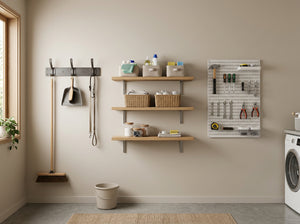

A clear wall can offer valuable storage, but the right solution depends on more than the space you can see. A row of hooks may tidy a collection of long-handled tools, while a shelf or dedicated organiser can make smaller items easier to find. The wrong choice can leave equipment awkward to reach or place more demand on the wall than the mounting arrangement can support.
The best wall-mounted storage starts with the items you own: their shape, dimensions, weight and how often you use them. From there, consider the available wall, suitable fixings and the space needed to lift things on and off. This guide walks through those decisions for garages, workshops and other spaces in Australian homes.
Start with what you need to store
Wall-mounted storage attaches to a wall to hold, organise or display belongings without relying solely on floor space. It can take the form of individual hooks, shelves, racks, purpose-built organisers or compatible panel systems.
Before comparing products, group your belongings by how they need to be held. A broom handle needs a different support from a row of small containers, and a cordless drill is easier to put away when its holder accommodates its shape.
Separate hanging items from items needing a surface
Hooks and brackets suit many objects with handles, frames or another suitable hanging point. Garden tools, chairs and some sporting equipment may fit this approach, provided the hook shape and dimensions suit the item.
Choose a shelf or rack when the contents need a level surface. Containers, small accessories and supplies are easier to arrange this way than on individual hooks. Check that the shelf is deep enough for the base of each item, without allowing it to overhang.
A dedicated organiser can be useful when several related tools are used together. It gives each item a more predictable place, although its fixed layout can be less adaptable if your collection changes.
Decide what needs to be within reach
Keep frequently used belongings where they can be removed and returned without moving other equipment first. A storage position that looks efficient when empty may be frustrating if a car, bench or door blocks access once the room is in use.
Reserve less convenient positions for lighter, less frequently used items that you can still retrieve comfortably. Avoid assuming that every available section of wall needs to be filled: leaving room around each item makes the system easier to use and adjust.
Compare wall storage types
The wall-mounted storage collection includes different approaches to organising a space. The best fit depends on whether you need individual hanging points, a surface for loose items or a more specialised layout.
Hooks for tools and bulky equipment
Individual hooks let you position storage around the items you already own. A small hook may suit a hand tool, while a larger profile can accommodate a bulkier object. Measure the part of the item that will rest on the hook as well as its overall size; a hook can be large enough to reach around an object yet poorly shaped to hold it.
The 12-pack of wall mount garage hooks includes five U-style and J-style hook types in different sizes. The steel hooks have a PVC coating, and the listing states a capacity of up to 18 kg. Confirm the applicable rating and suitable mounting arrangement for the individual hook before use; the product rating alone does not establish what a particular wall and fixing can hold.
Hooks are a good starting point when you have a mix of long-handled tools and larger equipment. Their limitation is that small loose items still need a container, shelf or another organiser.
Shelves for containers and visible supplies
Wall-mounted shelves provide a flat place for items that cannot hang neatly. They can work well for labelled containers, lightweight supplies or frequently used accessories, depending on the shelf’s stated capacity and suitability for the room.
Compare the usable shelf depth with the footprint of the items you intend to store. Also check the height between shelves if you are planning more than one level. A container must fit beneath the shelf above and leave enough room to lift it out.
A shallow shelf can keep a narrow area more open, while a deeper shelf can accommodate larger containers but projects further into the room. The additional projection matters in a garage walkway or beside a door.
Dedicated organisers for related tools
A purpose-built organiser can make sense when the same tools are used together and are regularly left on a workbench. It keeps their storage positions grouped, making it easier to see what has been put away.
For example, the wall-mounted cordless drill organiser measures 48.5 × 20 × 21 cm and has four lower holders, a shelf, side hangers and a rack for at least 10 screwdrivers. It is made from alloy steel and requires assembly. Its product page does not state a load capacity, so confirm the permitted load before relying on it for a particular collection of tools and batteries.
The trade-off is specificity. A drill organiser makes an excellent fit for the items it was designed around, but it may not replace a general shelf for larger cases or irregular equipment.
Panel systems for a changing layout
A compatible wall panel and accessory system can be useful when you expect the arrangement to change. Hooks and other fittings can provide multiple positions across a defined area, rather than requiring every stored item to have its own separate wall fixing.
Check which panel and accessories are included in the selected product or option. Do not assume a hook is compatible with every panel, or that a pictured combination is supplied as a complete set. Compare the cost and space needed for the panel and fittings together.
Measure the wall and the items together
A product’s width and height tell you whether the unit fits on paper. The more useful measurement is the space needed when it is loaded and being used.
Allow for projection and access
Measure the clear wall width and height, noting switches, windows, power points, door swings and anything already fixed to the surface. Then measure how far the proposed storage and its contents will project into the room.
For a hook, include the depth of the item hanging from it. For a shelf, include any container that extends beyond its edge. In a garage, check this clearance with the vehicle parked and its doors open, not only when the space is empty.
Allow room to lift an item clear of its support. A ladder stored close to the ceiling, for example, still needs a practical path off its hooks. Place adjacent items so their handles and frames do not catch each other during removal.
Plan around the shape of your collection
Lay out the largest items first, then use the remaining spaces for smaller pieces. Long-handled tools often benefit from a vertical arrangement, while shorter items may fit above a bench or alongside a door.
For a shelf of containers, measure both the largest base and the tallest container. If you expect to add more items, leave a little spare capacity in the layout rather than selecting a unit that only fits today’s collection exactly.
Marking the proposed outline on the wall before purchase can reveal an awkward door swing or a shelf that projects into a walkway. It also helps you see whether the fixing positions align with suitable support.
Check load capacity, wall type and fixings
A wall-mounted product’s stated capacity is only one part of the decision. The complete arrangement also depends on the wall material, its condition, the mounting points, the fixings and how the load is applied.
Read the rating carefully
Check whether the stated limit applies to each hook, each shelf, the whole unit or a particular installation arrangement. Include the weight of containers and their contents, not just the empty organiser. For a shelf, consider how the load will be distributed rather than concentrating everything at one end.
If the listing does not explain the capacity or the conditions behind it, seek clarification before buying or loading the product. Do not infer a capacity from the material, appearance or size of the hardware.
Match the mounting method to the wall
Australian homes and garages can have different wall surfaces, including plasterboard, timber, brick and concrete. Each needs an appropriate mounting approach. A fixing supplied with a product is not automatically suitable for every surface or every intended load.
Follow the product instructions and select fixings appropriate to the wall and load. Where the instructions require attachment to structural support, locate that support before deciding on the final position. If you cannot identify the wall construction or are uncertain about a heavy installation, seek advice from a suitably qualified installer.
Check for concealed services before drilling. If you rent, obtain any required permission before making holes and consider whether a freestanding option would be more suitable.
Choose materials and finishes for the room
Material and finish affect how a storage unit looks and how well it suits its intended environment, but they do not replace a stated load rating.
Steel and coated hooks
Steel is common in workshop organisers and hooks because it provides a structured form for holding tools. A coated hook surface can also be useful where stored equipment rests directly against the metal.
Look at the whole setting before choosing a finish. A garage, laundry or shed may be exposed to moisture or changing conditions; check the product description for its intended use and care guidance. Do not assume that a coating makes every product suitable for outdoor exposure.
Shelves and brackets
When buying a shelf and brackets separately, confirm that the components are compatible in depth, thickness, mounting method and intended load. The capacity of the finished arrangement depends on all of its components and the wall fixing, not simply the highest rating shown on one part.
For visible storage in a living area or bedroom, finish and shelf profile may matter as much as capacity. In a workshop, easy access and a practical surface may take priority. In either case, choose a design that supports the actual objects rather than buying by appearance alone.
Wall-mounted storage or freestanding shelving?
Wall storage is useful when you want selected items off the floor and close to where they are used. Hooks can make individual tools easy to see, and a compact organiser can clear a workbench without taking up another section of floor.
Freestanding units offer a different advantage: multiple shelf levels for boxes and supplies, without requiring every item to be attached to the wall. Browse storage shelves when you need more surface area for containers or when drilling is not appropriate. Check the product instructions for assembly, loading and any anchoring requirements.
Many rooms benefit from both. A shelving unit can hold boxed supplies, while a nearby wall rack keeps the tools used most often within reach. Leave enough clearance between them to retrieve items without twisting or lifting over an obstruction.
Avoid common wall storage buying mistakes
Buying by appearance before checking the contents
A neat row of matching hooks may look appealing, but mixed equipment often needs different shapes and sizes. Check the thickness of handles, the width of frames and whether each object has a suitable hanging point. If an item cannot rest securely in the hook’s intended position, choose another storage method.
Treating the product rating as the wall rating
A strong-looking hook cannot compensate for an unsuitable fixing or a wall that cannot support the intended load. Check the complete arrangement, including the wall surface and the instructions for the selected product. Where capacity information is missing, resolve that question before loading it.
Forgetting the space needed to remove things
A fully packed wall can be harder to use than a smaller, well-spaced setup. Check that a shovel can be lifted off its hook without hitting the ceiling and that a drill can be removed from its holder without catching on the shelf above.
Overlooking changes in the room
A storage location beside a bench might be convenient now, but a future cabinet, vehicle or appliance could block it. If your needs are likely to change, individual hooks or a compatible adjustable system may offer more flexibility than a fixed arrangement.
Before marking your final drill points, place your longest tool against the planned wall position and trace the path it will take as you lift it free. That simple check can expose a clearance problem that neither the hook dimensions nor the empty wall measurements will show.
Frequently asked questions
Can wall-mounted storage be installed on plasterboard?
Some wall-mounted products may be suitable for a plasterboard wall when installed with the correct support and fixings, but suitability depends on the product and intended load. Follow the mounting instructions and check whether attachment to structural support is required. If you are unsure what is behind the wall or which fixing to use, seek advice from a suitably qualified installer before drilling.
How much weight can a wall storage hook hold?
The permitted weight varies by hook and installation. Check whether the manufacturer’s rating applies to each individual hook and what mounting conditions it assumes. The wall, fixing and condition of the mounting surface also matter. For example, a product listed at up to 18 kg should not be assumed to hold that load on every wall or with every fixing.
Are wall hooks or shelves better for a garage?
Hooks are useful for items with suitable handles or frames, while shelves provide a surface for containers and loose supplies. The better choice depends on what you need to store and how you retrieve it. A garage with long-handled garden tools may benefit from hooks; a collection of small boxes may be easier to manage on shelving. Many spaces use both.
Can I use wall-mounted storage in a rental home?
Possibly, but check your rental agreement and obtain any required permission before drilling or adding permanent fixings. Consider where holes would be needed and whether the installation can be removed and the wall restored as required. If permission or a suitable mounting surface is unavailable, a freestanding storage shelf may be a more practical option.
How do I maintain wall-mounted shelves and hooks?
Keep the storage surface clean and periodically check the mounting points and components for looseness, damage or wear. In damp areas, also look for signs of corrosion where relevant. Follow the product’s care instructions, and avoid adding items beyond its stated capacity. If a fixing or component appears damaged, remove the load until the issue has been assessed.
How much does wall-mounted storage cost?
The cost depends on the type and size of storage, the number of components and whether suitable fixings are included. Compare the complete setup: a panel system may need compatible accessories, while a shelf project may need separate brackets and a board. Installation can add to the cost if you need professional help. Check current product pricing before deciding.
-
 Tags:
Wall-Mounted Storage