1300 760 441
 cs@factoryfast.com.au
Garage Storage and Shelving: How to Choose the Right Setup
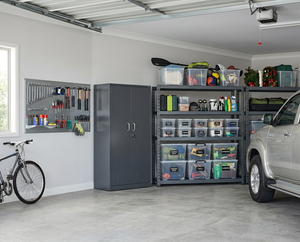

A garage shelf can look like a good fit online and still leave you with a problem: boxes that overhang, tools that exceed a shelf’s capacity, or a car door that no longer opens comfortably. The right setup starts with what you need to store and how much space you can use, then narrows down to the right rack size, shelf material and load rating.
This guide explains how to compare garage storage and shelving for Australian homes, from compact shelves for everyday supplies to adjustable racks for heavier equipment. Browse the garage storage and shelving collection as you work through the choices.
Start With What Your Garage Needs to Store
Garage storage is rarely one job. A single space might hold car-care products, gardening equipment, sporting gear, household supplies and tools. Grouping those items by size, weight and frequency of use will help you choose a setup that works after the initial tidy-up.
Sort by weight and shape
Start with the heaviest and bulkiest items, because they place the greatest constraints on your choice of shelf. A toolbox, for example, needs both enough shelf capacity and a surface deep enough to support its base. Tall containers may need adjustable shelf spacing, while small loose fittings are easier to manage in a box or tray.
Make a separate note of anything unusually long, awkwardly shaped or unsuitable for a shelf. A rack designed around boxes will not necessarily solve storage for a long-handled tool. Those items may need their own space or a different storage format.
Separate daily access from occasional storage
Place frequently used items where you can reach and return them without moving several other things first. Seasonal supplies and infrequently used equipment can go in less convenient positions, provided they remain within the rack’s stated limits and can be handled comfortably.
This also helps you decide between open and enclosed storage. Open shelves make contents visible at a glance. A cabinet can be useful when you prefer doors or want to separate smaller supplies from the rest of the garage.
Choose the storage type before the finish
Use this sequence to narrow your options:
- Choose open shelving for easy access, or investigate a cabinet if enclosed storage is the priority.
- Decide whether the unit should stand on the floor or whether wall-mounted storage is better suited to the available space.
- Measure the largest items and the space available around the parked vehicle.
- Compare the required load with the capacity stated for each individual shelf.
- Select a shelf surface and finish suited to the items and the garage environment.
If one unit cannot accommodate everything without awkward stacking, two smaller zones may work better than one oversized rack.
Compare Garage Shelving, Cabinets and Wall Storage
Freestanding garage shelving units
Freestanding racks suit buyers who want to organise boxes, equipment and supplies across several levels. They make use of vertical space and usually offer more flexibility than a single shelf. Some have adjustable tiers, which are helpful when one level needs to accommodate tall containers and another holds shallow cases.
Check the unit’s complete dimensions, not just its height. A wide rack may hold more along a wall, while a narrower one can fit beside a doorway or in an otherwise awkward space. The deeper the rack, the more floor area it occupies when items are loaded.
Freestanding does not mean anchoring can be ignored. Check the product’s instructions and any supplied anchoring requirements before choosing its position.
Storage cabinets
A cabinet is worth considering when you want contents behind doors rather than on display. It can suit a garage that doubles as a household storage area, particularly for items you do not need to see throughout the day.
Allow space for doors to open fully and for you to stand in front of them. Check the internal shelf dimensions and load limits as well as the external footprint: a cabinet that fits against the wall may still be too small inside for a large tool case.
Do not assume that every cabinet locks or that it is suitable for every stored substance. Check the individual listing and follow the storage directions on the items themselves.
Wall-mounted storage
Wall-mounted storage can keep the floor clearer and bring smaller items within reach. It may complement a freestanding unit, especially where a work area needs frequently used supplies close at hand.
The important decision is not simply whether there is empty wall space. The wall construction, mounting position, fixings and product instructions all matter. Check compatibility before purchasing, and avoid assuming that a wall shelf will carry the same load as a floor-standing rack.
How to Measure for Garage Storage Racks
Measure width, depth and height
Measure the clear wall width where the unit will sit, then check for obstacles such as power points, pipes, door frames and fixtures. Note whether skirting or other projections affect how close a rack can sit to the wall.
Measure depth from the wall into the usable floor area. Think about the loaded shelf, not just the empty frame: an item that projects beyond the front edge can make a walkway or parking space less convenient.
For height, check the clearance below ceiling fixtures, garage-door mechanisms and anything else that could interfere with assembly or access. A tall unit offers more levels, but its highest shelf is only useful if you can reach and load it appropriately.
Check the car and the walkway
Measure with the vehicle in its normal parked position. Open its doors and boot, and allow for the path you actually use to enter the house or move around the garage. A rack that technically fits on paper can be frustrating if it forces you to unload shopping sideways or move a bike every time you park.
Also consider how items will come off the shelves. A storage box needs enough room to slide forward before you lift it. A cabinet needs door clearance, and a large tool case may need space to turn as it is carried out.
Match shelf spacing to your containers
Measure your tallest planned container including its lid, handles and anything placed on top. Leave enough clearance to lift it out without tilting or dragging it against the shelf above.
Adjustable garage shelving is useful when container heights differ or your needs may change. Before buying, check that the product actually offers adjustable levels and that the available arrangement suits your items. External dimensions alone do not tell you the usable space between shelves.
For a broader choice of footprints and shelf formats, compare the storage shelves collection alongside the dedicated garage range.
Understand Shelf Capacity Before Buying
Per-shelf capacity is not the same as total capacity
The most useful rating is the one that applies to the way you intend to load each tier. A rack’s total capacity does not mean that all of that weight can be placed on one shelf. Likewise, a high per-shelf figure should not be treated as permission to exceed a stated overall limit.
Factory Fast lists its Garage Shelving Units, 2-Pack 5-Tier Adjustable Steel Racks with a stated capacity of 200 kg per tier and 1,000 kg per rack. Each rack is listed as 90 cm wide × 40 cm deep × 180 cm high. The set contains two racks, so it may suit a buyer planning separate storage areas or a longer run along a wall.
Those figures apply to that listed product, not to all steel shelving. Check the current product details and any conditions for distributing and supporting loads before ordering.
Work out the weight of a real shelf load
Add the weight of the container to the contents you plan to put inside it. Then consider whether you may add more later. Several small items can become a substantial load when packed into one box, and a shelf full of tools can weigh much more than it looks.
Keep the load within the product’s stated limits and follow its instructions for distribution. Avoid relying on a capacity figure when the listing does not explain an important detail you need. Ask for clarification before making a purchase decision.
Think about stability as well as strength
Capacity is only one part of a workable setup. The rack must be assembled correctly, positioned on a suitable surface and used as directed. Place heavy items lower down where practical, and avoid creating an arrangement that makes the unit difficult to load or unload.
Check the manufacturer’s anchoring instructions and use the required anchor device. Do not let children climb or hang from shelving. If the intended location has an uneven floor or an unsuitable wall for the specified anchoring method, resolve that before filling the unit.
Choose the Right Shelf Material and Surface
Solid metal shelves
A solid shelf supports the base of a container across its surface and can be convenient for smaller items that might otherwise sit awkwardly on an open wire shelf. It can also make it easier to keep separate boxes or trays in place.
Compare the shelf material as well as the frame material. Two racks may both have steel frames while using different shelf surfaces, so a product described as metal shelving is not necessarily constructed the same way throughout. Check the individual listing if moisture exposure or the surface itself is important to your choice.
Wire shelving
Wire shelves offer an open surface that helps you see what is stored and allows airflow around items. They can work well for larger containers, cases and supplies that sit securely across the shelf.
The Wire Storage Rack, 60 × 60 cm Black Shelving with Fixed Legs is listed with four adjustable wire shelves, a 180 cm height and a stated 100 kg capacity per layer. Its square footprint is useful to compare with a wider, shallower rack: it needs less wall width than some wider units, but projects further into the room.
For small or narrow items, consider placing them in a suitable container rather than directly on the wire. Check that the loaded container remains within the shelf’s stated capacity.
Finishes and garage conditions
Garages differ. Some are enclosed and dry; others are exposed to damp conditions when doors are open or wet equipment is brought inside. Look at the material and finish described for the exact product, and avoid assuming that a coated or galvanised frame makes every component suitable for constant moisture.
Keep shelves clean and dry in line with the product instructions. If you need to store damp items, check the listing’s suitability and consider how you will prevent water collecting on the unit or its contents.
Plan a Layout That Makes Everyday Access Easier
Give each storage zone a purpose
A useful garage layout puts related items together. For example, keep car-care supplies in one area and gardening supplies in another, rather than spreading each group across every shelf. This makes it easier to find what you need and see when an item has not been returned.
Give the most accessible shelf space to the items you use regularly. Reserve less accessible positions for lighter, occasional-use items, provided you can retrieve them comfortably and follow the unit’s instructions. Heavy toolboxes and dense containers are generally more manageable lower down.
Use containers to support the shelf layout
Containers help group small or awkward items, but their dimensions matter. A deep tub may fit the shelf footprint while leaving too little room above it to remove the lid. A wide case may fit between uprights only when turned sideways, making its handle hard to reach.
Before buying several matching boxes, test the intended arrangement against the shelf’s usable dimensions. Labels facing the aisle can make similar containers easier to distinguish without removing each one.
Leave room for change
A garage rarely stays organised around exactly the same possessions forever. Adjustable tiers can accommodate a taller container later, while separate units offer the option of organising different areas independently.
Do not fill every shelf to its physical or stated weight limit just because space is available. Leaving some room makes it easier to return items, reorganise a category or accommodate a new tool without stacking it precariously.
Common Garage Shelving Mistakes to Avoid
Buying by appearance or headline capacity alone
A rack may look substantial but still have the wrong depth, shelf spacing or capacity for your intended load. Read the dimensions, construction and load information together. If a listing provides an overall rating but not the detail needed for your planned use, seek clarification rather than guessing.
Equally, avoid paying for capacity you do not need at the expense of a footprint that fits. A smaller rack with the right shelf surface and usable spacing may be the more practical choice for lighter household supplies.
Forgetting assembly and anchoring
Check whether assembly is required and whether the unit uses a boltless system or another method. Adjustable shelves are useful only when assembled and positioned in accordance with the instructions. Confirm what anchoring is required, what is supplied and whether the intended wall can accommodate it.
Plan the assembly location too. A tall rack may be awkward to manoeuvre into a tight space once assembled, particularly around a parked car or fixed cabinets.
Treating every garage item the same way
Not everything belongs in an open tub on a rack. Small fittings may need a lidded container; long tools may need a separate solution; and products with specific storage directions need to be handled according to their labels. Shelving should support those needs rather than dictate an unsuitable arrangement.
Before ordering, take one of your largest loaded containers into the garage and rehearse the route from the proposed shelf to the exit. If you cannot lift and turn it comfortably with the car parked, adjust the rack position or choose a smaller container before committing to the layout.
Frequently Asked Questions
How much weight can garage shelving hold?
Capacity varies by product and often by shelf. Check both the stated limit for each tier and any overall limit, as well as the instructions for distributing the load. Add the weight of each container and its contents when planning. If the listing does not provide the rating or conditions needed for your intended use, seek clarification before buying.
Can garage shelves be installed on an uneven floor?
An uneven floor can make positioning and loading a rack more difficult. Check the product instructions for the required surface and any adjustment or anchoring provisions before installation. Do not assume that every fixed-leg unit can be levelled. If the floor prevents the unit from sitting as instructed, resolve the location or surface issue before putting items on it.
Is boltless shelving difficult to assemble?
Boltless shelving uses a different assembly method from a rack fastened together with bolts, but the exact process depends on the product. Check the listing and instructions for the components, tools and assistance required. Allow enough clear space to assemble and position the unit, then install any required anchoring before loading the shelves.
Are wire shelves suitable for small garage items?
Wire shelves can hold small items when those items are placed in an appropriate box or tray that sits securely on the shelf. Loose fittings may be awkward on an open surface. Measure the container’s base and height, and include the container’s weight when checking the shelf capacity. Choose a solid surface if that better suits what you store.
How much does garage shelving cost in Australia?
Cost depends on the size, number of units, construction and features such as adjustable shelves. Compare what is included in each listing: a set containing two racks is not directly comparable with the price of one unit. Check the current product price and delivery cost for your location before deciding, as listings and availability can change.
Can I put garage shelving next to my car?
Yes, provided the chosen location leaves enough room to park, open doors and access both the vehicle and the stored items comfortably. Measure with the car in its usual position and account for anything that may project beyond the shelf. Check the rack’s anchoring instructions and avoid placing it where it obstructs the garage door mechanism.
 Tags: