1300 760 441
 cs@factoryfast.com.au
L-Shaped Lockers vs Full-Height Lockers: Which Is Better for Your Space?
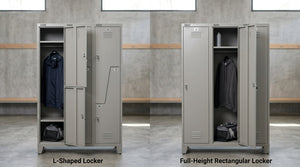

When staff need somewhere to hang a coat or uniform, a small multi-door locker may not be enough. The next choice is often between a full-height compartment for one person and an L-shaped layout that gives two people separate hanging areas within one cabinet.
Neither is automatically the better option. The right choice depends on how many people need storage, what else they carry and whether the available wall space is better used for one larger compartment or two individual ones.
Explore the metal lockers range with the intended contents in mind, then compare the cabinet’s internal arrangement as well as its overall footprint.
What Is an L-Shaped Locker?
An L-shaped locker has two interlocking compartments, each accessed through its own L-shaped door. The design gives two users separate storage while making room for hanging clothing within a narrow cabinet.
The grey two-door L-shaped locker measures 180 cm high, 40 cm wide and 45 cm deep overall. Each compartment has a hanging rod and a key-operated lock with two keys supplied per lock. The cabinet has ventilation slots and a recommended total weight capacity of 80 kg.
The important distinction is that each compartment is shaped around the other. Do not assume that the full width of the cabinet is available to each user along its entire height. Check the usable interior and opening dimensions if a particular bag, garment or piece of equipment must fit.
What Is a Full-Height Locker?
A full-height locker provides one person with access through a single tall door. Depending on the model, the interior may include a hanging rod, shelves or both.
The grey single-door combination locker measures 180 cm high, 38 cm wide and 45 cm deep overall. It has a hanging rod, top and bottom shelves, ventilation slots and a recommended total weight capacity of 30 kg.
One user has access to the whole cabinet, but that does not mean every item can occupy the full height. The shelves and hanging arrangement divide the space, so check the interior layout against the belongings that need to fit together.
Compare the Space Per User
Choose L-shaped compartments for two people
An L-shaped cabinet is worth considering when two people need separately locked areas for clothing and everyday belongings, but the room does not have space for two full-height units.
It can work well for employees who need a hanging area for a jacket or uniform and have a modest amount of additional gear. The trade-off is the irregular compartment shape: a wide or rigid item may not fit even when it appears compatible with the cabinet’s exterior dimensions.
Choose a single door for one person’s combined storage
A full-height unit can suit someone who needs to keep clothing and other belongings together behind one door. Shelves can help separate smaller items from hanging garments, subject to the selected model’s layout.
It may be the stronger choice for a dedicated staff locker when one person needs more continuous access to the cabinet. The trade-off is capacity: two users need two units if each requires their own lockable space.
Compare the Wall Space You Need
Using the two featured models as an example, one L-shaped unit occupies 40 cm of wall width and serves two users. Two single-door units, placed side by side, occupy a combined 76 cm of cabinet width and serve two users.
That comparison is useful for initial planning, but cabinet width is not the whole installation measurement. Allow for the actual position of skirting, nearby fittings, door swing and access. Follow the assembly and anchoring instructions for the selected products.
A narrow wall may favour the two-user design. A larger staff room may justify separate full-height units if each person needs the additional storage arrangement.
Check Hanging Length, Bags and Load Capacity
Measure the actual uniform
Measure the longest garment from where it hangs to its lowest point. Ask Factory Fast to confirm usable hanging length if it is not stated on the listing. Overall cabinet height is not a reliable substitute because rods, shelves and compartment shape affect the space available.
Test the rest of the contents
Consider the items stored alongside the garment: a lunch bag, shoes, helmet or personal bag may need a different shape of space. Measure rigid items in all three dimensions and check the door opening as well as the interior.
Read capacity figures carefully
A total cabinet capacity is not necessarily a per-compartment allowance. The L-shaped example lists an 80 kg recommended total; the single-door example lists 30 kg for the whole unit. Do not divide or redistribute a capacity without checking the product instructions.
Match the Lock to the Allocation
For a permanently assigned locker, a key-operated door can be straightforward when the workplace has a process for issuing and returning keys. Combination access avoids a daily key for the user, but forgotten codes still need a response.
The featured single-door combination model includes one master key per order, regardless of the number of units purchased. Additional master keys are available by special order. Confirm backup access for the exact model before ordering a bank of lockers.
Browse staff lockers if the room needs a mixture of full-height, two-user and smaller personal-storage compartments.
Plan for Assembly and Daily Access
Both featured cabinets are supplied flat-packed and require assembly. Check the delivery route and assembly area before purchase, then follow the supplied instructions and secure the furniture with an anchor device as directed on the product pages.
Before choosing the two-user layout, ask whether both people need to reach their lockers at the same shift change. If so, mark out the proposed position and check that the two users can approach their doors without a bench or another open door getting in the way.
Frequently Asked Questions
Can two people use one L-shaped locker?
Yes. The featured L-shaped cabinet has two separately lockable compartments, each with its own hanging rod. It is designed to give two users individual storage within one cabinet. Check the compartment shape and usable dimensions against each person’s belongings, particularly if both need to store bulky bags as well as clothing.
Is an L-shaped locker suitable for a long coat?
It may be, but suitability depends on the garment length and the usable hanging space in the specific compartment. Measure the coat from its hanging point to its hem and confirm the available length with Factory Fast if it is not listed. Also check whether shoes or a bag beneath the garment will crowd the space.
Does a full-height locker have shelves?
Some do, but the internal layout varies by product. The single-door model featured above has top and bottom shelves as well as a hanging rod. Shelves help organise smaller belongings, but they also affect the height available for larger objects. Review the product images and specifications before buying for a particular item.
Are L-shaped lockers supplied with padlocks?
The featured grey L-shaped model uses standard locks and includes two keys per lock. Other versions use different locking arrangements, including padlock-operated designs. Read the exact product listing rather than assuming that all colour or lock variants include the same accessories. A padlock-operated version may require a separately purchased padlock.
Can these lockers be used in a gym change room?
Factory Fast lists both featured models for gym use, and each has ventilation slots. Check the conditions of the intended location and the specific product instructions before installation. Ventilation provides airflow but does not make a cabinet waterproof; the suitability of a lock component should not be treated as proof that the entire unit can withstand direct water exposure.
Which layout is better for a small staff room?
An L-shaped cabinet can provide two separately locked spaces in less wall width than two comparable single-door units. A full-height cabinet may be more useful when each person needs the complete interior for clothing and other belongings. Compare the real contents, access space and user count before deciding which trade-off works for the room.
-
 Tags:
lockers