1300 760 441
 cs@factoryfast.com.au
Semi-Frameless Shower Screens Explained: Best Uses Pros and What to Check Before You Buy
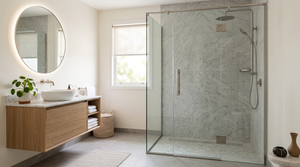

Semi-frameless shower screens make sense for a very large share of real bathroom renovations because they sit in the practical middle of the category. They give you a cleaner, more modern look than a fully framed unit, but they still keep enough structure around the glass to feel forgiving in everyday buying decisions. That matters when the room is compact, the walls are not perfectly true, or you want a strong finish without chasing the most minimal possible result.
Factory Fast’s semi-frameless shower screens collection makes that appeal clear. The category is positioned around layout flexibility, multiple configurations and everyday usability, which is exactly why semi-frameless remains such a strong choice for ensuites, family bathrooms and renovation projects where you want the room to feel upgraded without becoming overly demanding.
What a semi-frameless shower screen actually means
Semi-frameless uses a slimline perimeter frame to support selected sections of the glass, so you still get visible framing around some edges while the rest stays visually open. It bridges the gap between a fully framed shower screen and fully frameless glass, giving you cleaner lines and less bulk than heavier frames without losing useful structure.
This is part of why the category is often easier to live with. The frame support helps the screen feel more defined, while the reduced metal compared with a fully framed screen keeps the result from looking bulky. If you like the idea of a modern shower without wanting every component to feel ultra-minimal, semi-frameless is usually the more forgiving place to start.
Where semi-frameless screens work best
Semi-frameless screens are often strongest where the room needs a practical answer, not just a design statement.
Ensuites and small to medium bathrooms
Factory Fast describes semi-frameless screens as particularly suitable for small to medium bathrooms, renovation projects and rental homes because of their versatility. In a smaller room, that balance matters, and many homeowners find these designs work well in small bathrooms and compact bathrooms because the glass keeps sightlines open. This can bring in more natural light and help the bathroom feel larger. You still get a lighter look than a fully framed screen, but the product choice is often easier because the category includes more adjustable formats and practical opening styles.
Alcoves, corners and slightly imperfect walls
The collection also points out that adjustable mounting systems can accommodate minor wall variation common in homes. That is a major buying point. Not every bathroom opening is perfectly square, and semi-frameless products can make those conditions easier to handle. If you are shopping for a compact return-panel setup, it is also worth comparing the wider corner shower screens category so you can judge whether a corner or wall-to-wall layout suits the room better.
Buyers who want better value without looking basic
Semi-frameless is also an affordable option for budget conscious homeowners who want better value without the bathroom looking basic. Factory Fast notes that semi-frameless products are generally more affordable than frameless options, with the lower cost coming largely from thinner glass and simpler installation requirements than fully frameless models, which use thicker glass for durability. It usually sits between a fully framed screen and a fully frameless option on price, avoiding the higher price tag of all-glass designs while still looking stylish. That makes semi-frameless a sensible category when budget still matters but you do not want the bathroom to feel like a compromise.
What to look for in a semi-frameless product
The biggest mistake buyers make is assuming all semi-frameless screens are broadly the same. They are not. The details drive the real difference.
Glass thickness and structure
The adjustable chrome model is a strong working example because the page is specific. It uses 6 mm toughened safety glass, stands 195 cm high, includes a pivot door and is built around an adjustable front opening of 74 to 82 cm with a side panel range of 89 to 92 cm. When you compare products, check that the bathroom glass complies with australian standards, including AS/NZS 2208. Those numbers matter because they tell you this is not just a style label. It is a screen built for a particular kind of fit.
Reversible entry and closure details
That same chrome model also includes reversible left or right entry and a magnetic closing strip. Those are not minor extras. Reversible entry can save a layout when you need the door to open the more practical way, which matters with pivot door shower screens. They need clearance to swing, while a sliding door can suit tighter layouts better, and a magnetic close gives the enclosure a more finished everyday feel.
Hardware finish and upkeep
Factory Fast also lists a black semi-frameless version with the same core idea but a different side-panel range of 98 to 101 cm and a sharper, more graphic finish. Both examples include a glass coating designed to help reduce soap scum and limescale build-up, which is worth noting if the bathroom is used heavily and you want easier ongoing maintenance. Like frameless options, they are relatively easy to look after, and with fewer metal parts than traditional framed screens, regular cleaning of the glass panels helps prevent soap scum and mineral buildup.
Semi-frameless vs frameless: which buyer does each suit?
This is usually the question behind the category search. Buyers are not only trying to understand what semi-frameless means. They are deciding whether it is the smarter purchase than frameless.
Choose semi-frameless when fit flexibility matters
If the room needs a little tolerance, if you want a practical pivot-door enclosure, or if you are working in a bathroom where walls may not be perfectly true, semi-frameless is often the easier category to buy confidently and is usually faster to install than fully frameless because the external aluminium frame provides more support during fitting. The adjustable nature of many semi-frameless products makes them feel more realistic for standard renovation work. Precise fitting still matters so components align properly, avoid gaps, and reduce the risk of water leakage. Framed edges, outer metal tracks, and rubber seals can also improve water containment compared with frameless doors.
Choose frameless when visual simplicity is the main goal
If the bathroom design depends on an ultra-clean glass look and you want the hardware presence minimised, compare your options in the frameless shower screens collection; because there are no supporting frames around the edges, they rely on thicker toughened glass, often around 10 mm, for durability and structural integrity. Frameless tends to feel more design-led and more premium, but this frameless style uses minimal hardware for a sleek result, brings in more natural light, and can make the room feel more open, though it is not automatically the smarter purchase if the room itself would benefit from adjustability and a more structured enclosure. With fewer metal edges, it can also be easier to clean than a framed shower screen.
A buying checklist before you commit
Buy semi-frameless screens the same way you would assess a fitted product in any other category: by matching the details to the room.
Confirm the opening and return-panel measurements
Make sure you know whether the product dimensions refer to the front panel, the side panel, or an adjustable installation range. This is especially important in return-panel setups where a screen may fit one room beautifully and another only awkwardly.
Check the opening direction and door style
If the screen uses a pivot door, confirm the room has enough swing space. A fixed panel can suit walk-in layouts, while the right shower screen for tighter rooms may be a sliding door rather than a pivoting option. If the model offers reversible left or right entry, treat that as a major practical benefit rather than a small extra.
Choose a finish that belongs with the bathroom
Chrome stays flexible, while black creates more contrast and can make the enclosure read more strongly against pale tiles. Match the hardware with your other fittings so the screen feels integrated into the room rather than added at the end.
Think about daily cleaning, not only installation day
Semi-frameless models can be a good balance here because they keep a cleaner look than fully framed screens while still offering practical coated-glass features on selected models. If ease of upkeep matters, weigh that heavily in the decision rather than treating it as a secondary consideration.
Semi-frameless is often the most sensible modern choice
Semi-frameless shower screens are easy to underestimate because they sit between more obvious category labels. In practice, that middle position is exactly their strength. They offer a modern look, useful adjustability, structured enclosure feel and practical day-to-day features that suit the way many Australian bathrooms are actually renovated.
For buyers comparing real-world options at Factory Fast, semi-frameless is not the compromise category. It is often the category that makes the best overall sense. Start with the room dimensions, check the adjustment range, confirm the entry direction and choose the finish that fits the rest of the bathroom. Once those pieces line up, the decision becomes much clearer.
 Tags:
Tags: