1300 760 441
 cs@factoryfast.com.au
Motorised Awnings Buyer Guide: How to Choose the Right Outdoor Shade
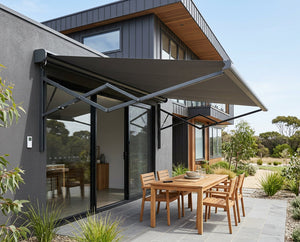

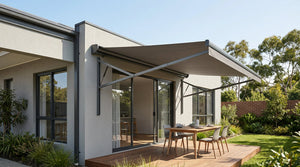
A patio can be ideal for entertaining until the sun reaches the table and there is nowhere comfortable to move. A motorised awning gives you another option: extend shade when you need it, then retract the fabric when you want the space open again.
The right choice depends on more than finding a colour that suits your home. Width, projection, mounting height, wall construction and access to power all affect whether an awning will work in your space. The housing and fabric matter too, particularly when the awning is exposed between uses.
This guide walks through those decisions so you can compare motorised awnings with confidence and choose a configuration that suits your Australian patio, deck or balcony.
What Is a Motorised Awning?
A motorised awning uses an electric motor to extend and retract its canopy. On a folding arm model, hinged arms carry the fabric out from the wall and fold back as the awning closes. This leaves the area underneath free from support posts.
Many models use a remote control. Some also include a hand crank, providing a manual way to operate the awning when needed. Features differ between products, so check the listing rather than assuming every electric model includes the same controls or backup option.
Browse the motorised awnings collection to compare available sizes and configurations. Before settling on one, work through the space and installation checks below.
Motorised vs manual operation
A motorised model suits a household that values push-button adjustment, especially when the awning will be opened and closed regularly. It does, however, need a suitable power arrangement as well as a mounting position.
A manual awning is worth considering if you prefer a hand-operated mechanism or do not have a practical power connection near the proposed location. Compare the wider retractable awnings range before deciding whether powered operation is important enough for your space.
Start With the Area You Want to Shade
The most useful measurement is not simply the size of your patio. It is the size and position of the area you actually want to use.
Identify the activity zone
Decide whether the priority is a dining table, a lounge setting, a doorway or a window. Note where chairs sit when people are using them, not just when they are pushed neatly under a table. For a balcony, include the space needed to move past furniture and open doors.
Watch where sunlight falls at the time you normally use the area. A canopy provides shade from above, but low-angle sun can reach underneath its front or sides. An awning that covers the furniture footprint at midday may not shade every seat later in the afternoon.
Measure width and projection separately
Awning width runs along the mounting wall. Projection is how far the awning extends outward from that wall. Both dimensions need to suit the intended use and the available space.
For example, a 4 × 3 m awning is listed as 4 m wide with a 3 m projection. Check that the wall can accommodate the width, then consider where the front edge will sit when extended. A wide canopy with insufficient projection may leave the outer seats exposed; a deep projection is less useful if it obstructs a path or extends beyond the area you can use.
Product dimensions describe the awning, not a guarantee that the same area will remain shaded throughout the day. The sun’s position, mounting height and canopy angle all influence the shade on the ground.
Check Mounting Height, Drop and Clearance
A folding arm awning needs enough room both against the wall and out in front of it. Measuring the wall width alone is one of the easiest ways to overlook a poor fit.
Allow for the canopy’s slope
The front of an extended awning sits lower than its mounting point when the canopy is pitched downwards. That drop affects headroom, door clearance and the position of the shaded area.
The grey full cassette example specifies an installation height of at least 2.5 m when fully extended and a total drop of at least 60 cm. These figures are specific to that model, not a rule for every awning. Check the instructions for the exact product and ask an installer to assess the available height before purchasing.
Look for obstacles above and below
Inspect the proposed mounting area for gutters, downpipes, lights, vents, eaves and other fixtures. Then consider the path of the canopy as it opens. A door that swings outwards, a balcony rail or a nearby structure may interfere with the extended awning even when the unit fits neatly against the wall.
Also check access to the mounting points and controls. A location that looks clear from the ground may leave little room for brackets or the casing. Keep the product dimensions handy when discussing the installation.
Full Cassette vs Open-Style Motorised Awnings
The housing is an important difference between models that otherwise offer similar shade. It affects how the awning looks when closed and how much of the retracted fabric and mechanism is enclosed.
Full cassette: enclosed storage when retracted
A full cassette awning folds the fabric and arms into a housing when closed. This creates a contained appearance and helps shield the retracted components from dirt, rain and sun exposure.
The 4 × 3 m grey full cassette motorised awning combines a remote control with a hand crank and a powder-coated aluminium casing. Its listed cassette measures 145 mm high by 220 mm wide, so check that the housing itself fits beneath eaves and around other wall features.
This style is worth considering when the closed awning will be prominently visible or when enclosing the fabric between uses is a priority. Allow for the casing dimensions as well as the canopy width.
Open-style: powered shade with a different housing arrangement
An open-style model offers motorised folding arm operation without the same fully enclosed cassette arrangement. It can be a useful choice when powered convenience and purchase price are higher priorities than a fully enclosed finish.
The 4 × 3 m grey motorised outdoor awning has a powder-coated aluminium frame, remote control, hand crank and an adjustable angle listed from 0° to 30°. It is supplied flat-packed and requires assembly. Its fixings are listed for brick and concrete walls only.
Compare the complete installation position as well as the headline price. A sheltered mounting location may influence how you weigh the housing choice, but it does not replace the need to follow the selected model’s care and operating instructions.
Compare Fabric, Frame and Finish
The canopy and frame work together, but their specifications answer different questions. Fabric affects the shade surface and its appearance; the arms, roller and mounting system support and operate the canopy.
Fabric and coatings
Polyester is used in the examples above. The full cassette model lists 280 g/m² polyester fabric with a UV 40+ rating. Its listing also notes that the fabric colour tone may be uneven because of the sun-protection coating.
Fabric weight and a stated UV rating are useful product details, but neither tells you everything about how a particular awning will perform in your location. Compare the full product description, follow its care instructions and check any detail that matters to your purchase with Factory Fast before ordering.
Choose a colour you are comfortable seeing both from the patio and from inside through nearby windows. On a prominent façade, consider the casing colour alongside the fabric rather than treating them as separate decisions.
Frame and hardware
The full cassette example lists aluminium folding arms and stainless steel nuts and bolts. The open-style example lists a powder-coated aluminium frame. These details help you compare construction, but they do not make the two products interchangeable: housing, fixings, assembly and clearance still need separate checks.
If you live near the coast or your mounting area is particularly exposed, describe the location when asking about suitability and care. Do not assume that every finish or fitting has the same maintenance needs.
Plan Power and Controls Before Ordering
A remote control is convenient only when the motor has a suitable power supply. Check the connection details for the specific awning and where the lead will reach from the intended mounting position.
The full cassette example lists a 2 m power cord with a sealed three-pin plug. Measure the route to the intended outlet, taking the position of the casing and any obstacles into account. Do not assume that a nearby indoor outlet provides a suitable outdoor connection. Ask a licensed electrician to assess the arrangement if a new outlet or electrical work is needed.
A hand crank can be useful if powered operation is unavailable, but it should be listed as an included feature rather than presumed. Likewise, do not assume a particular awning has an automatic weather sensor, timer or app control unless the product page explicitly says so.
Assess the Wall and Installation Requirements
A motorised folding arm awning places demands on its mounting surface. The wall must be suitable for the awning and its brackets, not merely wide enough to hold them.
Check the structure and supplied fixings
The two examples in this guide list supplied fixings for brick and concrete walls. That does not mean those fixings are suitable for every brick or concrete wall, or that they can be used on another surface.
If your home has cladding, a rendered surface or a wall construction you cannot identify, have the underlying structure assessed before buying. An experienced installer can advise whether the proposed location and fixings suit the product. For a rental property or strata-managed home, check the relevant permissions before arranging installation.
Account for assembly and access
Some awnings arrive flat-packed and need assembly. Others have different preparation and handling requirements. Check the listing and instructions for the model you choose, including the space needed to handle it and access the mounting position.
Get an installation quote using the product dimensions and site details. This is also a good point to confirm whether the wall, proposed height and power location work together. Changing one of those after purchase can change the size or style that fits.
Budget for the Complete Installation
A useful budget includes more than the price shown on the product page. Depending on your setup, allow for assembly, installation, any suitable alternative fixings, electrical work and delivery. Obtain quotes for your own site rather than relying on an assumed installation cost.
When comparing two awnings of the same width and projection, look at what explains the price difference: housing, construction, included controls and the work required to install each model. A full cassette may be attractive for its enclosed finish, while an open-style option may better suit a buyer prioritising a lower initial product cost.
Prices and availability can change. For a closer look at the components of a budget, read the motorised awning prices guide.
Use and Care: Protecting Your Awning Investment
A retractable awning is adjustable shade, not a substitute for checking the weather and the product instructions. Follow the operating limits for your exact model and retract it when conditions make continued use unsuitable. Do not transfer a wind figure from one listing to another: ratings, where provided, are model-specific.
Keep the fabric and mechanism clear of accumulated debris, and use the cleaning method recommended for the product. Before retracting, check for branches or other obstructions around the arms and front bar. If the fabric becomes wet, follow the product’s instructions for drying and storage rather than leaving it rolled away damp for an extended period.
An awning’s shade also moves as the sun moves. For a patio used mainly late in the day, check whether side-on sunlight reaches your seating position before assuming that a greater projection alone will solve the problem.
Make the Final Choice for Your Patio
Shortlist by the mounting wall and required clearance first. From the models that fit, compare width and projection against the furniture area, then choose the housing, controls and finish that suit your budget and how often you expect to use the space.
Before placing an order, mark the proposed mounting height and the projected front edge on a photo or sketch of your patio. Add the swing of any nearby door. Sharing that with your installer alongside the selected awning’s dimensions can reveal a clearance problem before the brackets go on the wall.
Frequently Asked Questions
Are motorised awnings worth it for a patio?
A motorised awning can be worthwhile when you want adjustable patio shade and expect to open and close it regularly. Remote operation makes changing the canopy position convenient, while a retractable design leaves the area open when shade is not needed. Weigh that convenience against the product price, installation requirements and the need for a suitable power connection.
Can a motorised awning be used manually during a power outage?
Some motorised awnings include a hand crank for manual operation, but not every model should be assumed to have one. Check the product listing and instructions before buying if backup operation matters to you. Keep the crank somewhere accessible and learn how to use it according to the supplied instructions before you need it.
Can I install an electric awning on a rendered or clad wall?
A rendered or clad surface needs an assessment of the structure behind it before you can determine whether it is suitable. The supplied fixings on some awnings are intended for brick and concrete, not automatically for other wall types. Discuss the product, wall construction and mounting position with an experienced installer before ordering or drilling.
Does a full cassette awning need cleaning?
Yes. A full cassette helps enclose the retracted fabric and arms, but the awning still needs care in line with its product instructions. Check the canopy and mechanism for debris, especially before closing it. Clean the housing and fabric using the recommended method, and follow the instructions for drying the fabric if it becomes wet.
Will a motorised awning keep out rain and wind?
An awning’s suitability for rain and wind depends on the specific product and its instructions. Do not assume a retractable canopy can stay extended in every condition, even when a listing provides a wind rating. Check the operating guidance for your chosen model, monitor changing weather and retract it when continued use would be unsuitable.
How much does a motorised awning cost to install?
Installation cost depends on the awning, wall construction, access and whether assembly or electrical work is required. Request a quote based on the exact model and your proposed location so the installer can assess the work involved. Include delivery and any necessary electrical work in your budget, and check the current product price before ordering.
Related Articles
-
 Tags:
Motorised Awning