1300 760 441
 cs@factoryfast.com.au
What’s the Difference Between a Wall Bed and a Murphy Bed?
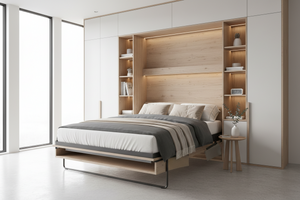

If you’ve been researching space saving furniture for your home, you’ve probably come across both terms and wondered whether they mean different things. The short answer is that, for most Australians shopping today, the difference between a murphy bed and a wall bed is largely a matter of terminology rather than function. Both describe a bed that folds away against a wall when not in use.
This guide is for Australian homeowners, renters, and anyone considering space-saving furniture solutions. Understanding the differences helps you choose the best option for your space and lifestyle.
This guide breaks down where the names came from, how modern products differ in practical ways, and what actually matters when you’re choosing between options for your spare room, studio apartment, or multipurpose living space.
If you’re looking to make the most of your living space, explore the wall beds collection for stylish solutions that fold away when not in use.
Quick Answer: Wall Bed vs Murphy Bed in Plain Terms
Let’s get straight to the point. In everyday Australian use, a wall bed and a murphy bed usually describe the same type of fold-away bed that stores vertically against a wall. You pull it down when you need to sleep, and you fold it back up to reclaim your floor space during the day.
Historically, the term murphy bed referred to a specific patented design, while wall bed is a broader, more descriptive term that simply means any bed anchored to or stored against a wall. Over time, though, the distinction has blurred. Most people use the names interchangeably.
Key Differences at a Glance:
-
Design Features: Wall beds often include built-in features like shelves and desks, while Murphy beds typically resemble regular furniture.
-
Terminology: The term "Murphy bed" originated from a brand name and is a subset of wall beds; "wall bed" is a broader term that encompasses various designs.
-
Mattress Accommodation: Wall beds can accommodate thicker mattresses, typically up to 12 inches, while Murphy beds usually require thinner mattresses, around 6 to 8 inches.
-
Built-in Features: Wall beds frequently offer integrated shelving, desks, or storage, while Murphy beds are more likely to be standalone units.
-
Mounting Method: Wall beds are anchored to the wall, while Murphy beds are typically free-standing.
-
Space-Saving Function: Both types allow a full-sized mattress to be concealed, maximizing floor space in small living areas.
Modern products in Australia often combine features from both original ideas: wall-mounted metal frame systems that look like cabinetry, built-in shelving, or even a wardrobe when closed. The bed disappears, and the room transforms.
The practical differences today tend to be about:
-
The type of lifting mechanism used
-
How deep the cabinet or enclosure is
-
What integrated furniture (desks, shelving, sofa units) comes with the system
-
Whether the bed folds vertically or horizontally
Comfort isn’t typically the difference. A well-designed system from either category can offer a comfortable bed that rivals a traditional bed frame. Keep reading to understand how mounting, mechanisms, and design details might affect your choice.
If you prefer a custom approach, the DIY space-saving queen wall bed cabinet with steel frame hardware kit gives you everything you need to create a functional Murphy bed tailored to your space.
Origins of the Terms “Murphy Bed” and “Wall Bed”
Understanding where these names came from helps explain why they’re used so loosely today.
The name “Murphy bed” originated in the early twentieth century with William Lawrence Murphy, who created a fold-up bed that stored in a shallow enclosure against the wall. His invention solved a real problem for small urban apartments, and the design caught on quickly. Over the decades, the Murphy name spread globally and became shorthand for any bed that folds up into a wall or cabinet, even when the product had no connection to the original company.
Explicit Definition: The term "Murphy bed" originated from a brand name and is a subset of wall beds, while "wall bed" is a broader term that encompasses various designs. Key distinctions between a Murphy bed and modern wall bed lie in design features and construction methods. The original Murphy bed folds into a closet, while modern wall beds can be integrated into custom furniture.
The term wall bed is more generic and descriptive. It simply means a bed that is anchored to, or closely aligned with, a wall and folds away when not in use. There’s no single inventor attached to it, which is why manufacturers and retailers often prefer it as a neutral label.
In modern Australian homes and showrooms, both names appear in brochures and conversations, often referring to very similar products. You might see one retailer call something a “premium wall bed” and another call an almost identical product a “high quality murphy bed.”
Design and engineering have evolved far beyond the original early 1900s models. Gas-pressurized piston systems replaced many older spring mechanism designs during the 1970s, making operation smoother and quieter. Yet the older names persist, which is why understanding the actual construction and features matters more than the label on the packaging.
Core Differences: How Wall Beds and Murphy Beds Are Typically Used Today
There’s no single global definition that separates these products cleanly, but there are common patterns in how people use the two names.
Wall bed often refers to systems that are clearly built into or mounted against the wall with visible cabinetry or joinery. These tend to look like permanent fixtures, blending with the room’s interior styles. When closed, a wall bed might appear as a full-height cabinet, a set of shelves, or part of a home office setup.
Murphy bed is frequently used for fold-down or fold-out designs that may look like a wardrobe, cupboard, or storage unit when closed. Some people use “Murphy bed” to mean a more traditional framed design with a spring system, while “wall bed” can suggest integrated modern joinery with shelving or desks attached.
For buyers, the meaningful differences are:
-
Mounting method: How the bed attaches to the wall and whether wall studs are required for secure installation.
-
Cabinet depth: How far the unit projects into the room when it is closed, which affects available floor space.
-
Appearance when closed: Whether the bed looks like furniture, cabinetry, or a standalone unit, impacting the room’s aesthetics.
-
Frequency of use: Whether the bed will be used daily or only occasionally for guests, which can influence the choice of mechanism and durability.
-
Integrated features: Desks, shelving, sofas, or storage options that can add multifunctionality and help maximize the use of space in your room.
By carefully evaluating these factors, you can select the best wall bed or Murphy bed solution tailored to your space and lifestyle needs.
In most Australian catalogues, the detailed product description—vertical or horizontal orientation, cabinet depth in centimetres, mechanism type—matters far more than whether the label says “wall bed” or “murphy bed.”
When updating small living areas with versatile solutions, integrating the queen DIY wall bed frame mechanism kit can help you create a Murphy bed that blends function with style.
Mounting, Mechanisms and Operation
This section explains how a typical wall bed or murphy bed is built and how it moves. Getting this right affects how easy the bed is to live with every day.
Mounting Methods
Many modern wall beds are mounted directly to a structural wall. The frame attaches to wall studs to prevent any movement or tipping when the bed is pulled down or pushed back up. Traditional murphy bed systems historically required this wall-stud anchoring because their spring mechanism generated considerable force during operation.
Some cabinet style murphy bed products use a surrounding cabinet that looks like fixed furniture when the bed is hidden. These may distribute weight differently and can sometimes be positioned without penetrating wall studs, though professional installation is still recommended for safety and stability.
Lifting Mechanisms Compared
Two main lift systems dominate the market:
Spring mechanism (coiled springs)
-
Uses metal frame construction with springs that provide counterforce
-
Holds the bed in its upright position through static spring pressure
-
Common in traditional murphy bed designs
-
May require more physical effort to operate
Piston mechanism (gas-pressurized pistons)
-
Uses gas cylinders similar to those in office chairs or car boot struts
-
Provides smooth, controlled motion when raising and lowering the bed
-
Often associated with modern wall beds
-
Allows surrounding cabinetry to be slimmer
-
Projects approximately 15 centimetres less into the room when deployed
Some newer simplified designs eliminate mechanical aids altogether, relying on manual lifting. These are lighter and less expensive but work best when two people share the heavy lifting.
When evaluating options, pay attention to:
-
How the bed is anchored (wall studs or freestanding cabinet)
-
What kind of lifting mechanism it uses
-
Whether the operation feels light enough for daily use or only occasional guest room deployment
Vertical vs Horizontal Layouts
Both wall beds and murphy beds can be configured vertically or horizontally. This choice has a much bigger impact on how the room works than which name appears on the product.
Vertical layout
-
The head of the mattress is at the top near the wall
-
The bed swings down to full length into the room
-
Requires approximately 150 centimetres of wall width for a full-size bed
-
Queen size needs around 166 centimetres of wall space
-
Suits standard ceiling heights (216 centimetres and higher)
-
Best when there’s plenty of clear open space in front of the wall
-
Allows exit from either side of the bed, useful for couples with different sleep schedules
Horizontal (side-folding) layout
-
The long edge of the mattress runs along the wall
-
The bed swings out sideways, projecting less distance into the room
-
Requires approximately 203 centimetres of wall width for a full-size bed
-
Queen size needs around 216 centimetres
-
Works well in long, narrow rooms or spaces with lower ceilings
-
Ideal under sloping roofs, in converted attics, or combined with a desk
Regardless of the label, the choice between vertical and horizontal mounting shapes how you walk through the room, where you place other furniture, and how the entire room functions day to day.
Design, Aesthetics and Integrated Furniture
Appearance and extra features are often where buyers notice the most meaningful differences between products.
Integrated Furniture Options
Many wall beds are designed as full-height cabinets that run along a wall. These can be paired with:
-
Open shelves for books and display items
-
Closed cupboards for linens or storage
-
Display units with lighting
-
Built-in home offices with desk surfaces
Some Murphy-style beds are presented as individual pieces that look like a wardrobe, storage unit, or sideboard when closed. They function as standalone furniture rather than built-in joinery.
Modern systems can incorporate built-in desks that remain level as the bed lowers. This helps a room function as both a home office and a guest room without requiring you to clear the desk every time someone stays over. For anyone working from a spare room, this trade off between workspace and sleeping space becomes a daily consideration.
Other options incorporate sofas, allowing a bed to fold down over or behind seating. This turns a living space into a sleeping space at night—perfect for a studio apartment where square footage is limited and every piece of furniture needs to work harder.
The biggest visual difference is usually not the name, but how the closed bed blends into existing joinery, wall finishes, or living room furniture. A well-designed system can make most people assume they’re looking at a closet, bookshelf, or entertainment unit rather than a comfortable bed waiting to be deployed.
Example scenarios for Australian homes:
-
A spare room in a Sydney apartment becomes a full-time study with a wall bed, desk, and shelving. When family visits, the desk stays clear and the queen size bed folds down in seconds.
-
An open-plan living area in a Melbourne townhouse uses a cabinet style murphy bed with a sofa in front. During the day, it’s a normal living space. At night, guests have a proper bed without anyone sleeping on the floor.
-
A Perth granny flat uses a horizontal wall bed under a sloping roofline, maximising head height while still providing a comfortable sleeping area.
Cabinet Depth and Projections
Cabinet depth and open projection influence how easy the bed is to live with, especially in smaller Australian bedrooms and apartments where every centimetre counts.
Slimmer wall bed cabinets:
-
Reduce how far the unit comes into the room when closed
-
Typically work best with moderate mattress thicknesses (around 20 to 25 centimetres)
-
Create more open space during the day
-
May limit storage options within the cabinet itself
Deeper cabinet-style murphy beds:
-
Can disguise the bed as a substantial piece of furniture
-
May allow for additional storage overhead or to the sides
-
Accommodate thicker mattresses more easily
-
Work well when the bed needs to blend with existing wardrobes or built-in robes
Indicative measurements:
-
The typical cabinet depth when closed ranges from 30 to 50 centimetres.
-
When the bed is opened in a vertical orientation, it projects approximately 200 to 220 centimetres into the room.
-
For horizontal openings, the projection is less, about 100 to 120 centimetres.
-
Additionally, you should allow at least 60 centimetres of clearance in front of the bed beyond the mattress length to ensure comfortable movement around the space.
Before committing to a particular depth and orientation, measure your room length, ceiling height, and circulation paths. Note where doors swing, where built-in robes sit, and how much floor space you need to walk comfortably when the bed is down.
Also consider how frequently the bed will be opened. A guest room used a few times a year can tolerate a slightly deeper cabinet that requires more effort to access. A bed used every night in a studio apartment should prioritise a slimmer profile and effortless lift system.
Mattress Options and Sleeping Comfort
For most people, comfort matters more than whether the product is labelled a wall bed or murphy bed. A fold-away bed that leaves you tired and sore defeats the purpose of having one.
Many modern wall bed systems are built to take standard mattress sizes common in Australia:
-
Single (92 x 188 centimetres)
-
King Single (107 x 203 centimetres)
-
Double (138 x 188 centimetres)
-
Queen (153 x 203 centimetres)
Some designs, particularly compact cabinet style units, may require a mattress within a specific thickness range so the bed can close properly. A mattress that’s too thick won’t allow the frame to lift fully into the cabinet. One that’s too thin may shift during folding.
Before purchasing or reusing an existing mattress:
-
Confirm maximum mattress thickness specified by the manufacturer (often 25 to 30 centimetres)
-
Check weight capacity for the frame and mechanism
-
Ensure the mattress won’t compress unevenly when stored vertically
A well-designed wall bed or murphy bed can offer a sleeping experience similar to a conventional bed when matched with a quality mattress and supportive base. The difference between a comfortable night and a disappointing one often comes down to mattress selection rather than the frame itself.
Use Case Examples and Recommended Mattress Types:
-
Nightly use (studio apartment or main bedroom): Medium to firm support mattress made of quality foam or pocket springs, providing consistent comfort for regular sleep.
-
Guest rooms (occasional use): Lighter weight mattresses that are easier to lift, while still offering moderate comfort for visitors.
-
Children's rooms or play spaces: Mattresses with durable covers, moderate thickness, and easy maintenance to withstand active use.
Balancing mattress comfort against cabinet depth and available floor space is one of the key factors in getting this decision right. A thicker, more comfortable mattress requires a deeper cabinet, which eats into your room. For smaller Australian homes and apartments, finding the perfect fit often means testing various sizes before committing.
Best Use Cases: Choosing What Suits Your Space
The ideal choice depends on room type, how often the bed will be used, and how flexible the space needs to be. Here are scenarios where different configurations shine.
-
Spare room / home office combination: A built-in wall bed with shelving and a desk can turn a spare room into a full-time study that converts into a comfortable guest room when required. The desk stays clear, the shelving holds books and files, and the bed appears only when needed. This is the perfect solution for homes where dedicated guest bedrooms feel like wasted space.
-
Multipurpose living room: A cabinet style fold-down bed suits open-plan areas where the bed needs to disappear completely during the day. When closed, it looks like furniture. When open, it provides a proper sleeping space without anyone feeling like they’re camping on a sofa.
-
Long, narrow rooms or low ceilings: A horizontal configuration works well in spaces that lack depth but have adequate wall width. This includes children’s play areas that double as guest spaces, rooms under sloping roofs, or converted attics where vertical beds would hit the ceiling.
-
Studio apartment: A wall bed with a sofa creates a separate “living zone” and “sleeping zone” within the same floor area. During the day, the sofa faces out into the room. At night, the bed folds down, and the space transforms. This save space approach is essential when your entire living space fits into a single room.
Questions to guide your decision:
-
Who will use the bed? Adults, children, older guests with mobility concerns?
-
How often will it be opened? Every night, weekends only, a few times a year?
-
Is integrated storage or a desk a priority, or is the bed the only requirement?
-
What’s your available wall space in centimetres?
-
Does the room have features (windows, doors, built-in robes) that limit where the bed can go?
The decision is less about the name and more about layout, mechanism, and how the furniture supports everyday routines in an Australian home.
Summary: How to Decide Between a Wall Bed and a Murphy Bed
In practical terms, wall beds and murphy beds are variations of the same fold-away concept. The terminology matters less than the specifications.
Main factors to compare when shopping:
-
Room dimensions: Measure the length, width, and ceiling height in metres to ensure the bed fits comfortably in your space.
-
Orientation: Decide between a vertical or horizontal layout based on your available wall space and the depth of the room.
-
Mechanism type: Choose between a traditional spring system or a modern piston lifting mechanism, considering ease of use and frequency of operation.
-
Cabinet depth: Check how far the unit projects into the room when closed to ensure it suits your floor space.
-
Mattress compatibility: Verify the maximum mattress thickness and weight capacity that the bed can accommodate.
-
Integrated features: Consider whether you want additional elements such as a desk, shelving, sofa, or storage cabinets included.
-
Installation requirements: Understand if the bed needs to be mounted to wall studs and whether professional installation is recommended or required.
Aesthetics and integrated features shape how well the solution blends with existing furniture and how flexible the room becomes. A bed that looks like a closet when closed transforms how you experience the entire room.
Before you start browsing options, sketch your room and note key measurements. Decide whether you want a built-in wall system that becomes part of the architecture or a cabinet style fold-down bed that functions more like standalone furniture.
Think about who will operate the bed. If it’s used nightly, a smooth piston mechanism makes the difference between a simple routine and a frustrating chore. If it’s purely for occasional guests, a traditional spring system might serve just as well.
The space savings from either approach can be substantial. A queen size bed that folds into the wall frees up several square metres of floor space during the day—enough for a home office, play area, or simply more room to move.
Choosing thoughtfully between these closely related designs can unlock valuable living space and functionality without compromising on comfort. Whether you call it a wall bed or a murphy bed, the right system transforms how your home works, giving every room the flexibility to do more than one job. Take your measurements, consider your daily routines, and find the perfect model for your space.
To enhance both comfort and design throughout your home, browse our full range of bedroom furniture featuring pieces that balance function and style.
FAQ's
What’s the difference between a wall bed and a Murphy bed?
A wall bed and a Murphy bed refer to similar space-saving furniture designed to fold away against a wall when not in use. The main difference lies in terminology and slight design variations. Wall beds often feature integrated cabinetry and modern piston mechanisms, while Murphy beds may have traditional spring systems and freestanding cabinets. Both provide practical solutions for maximizing floor space in guest rooms, studio apartments, or multipurpose living areas.
Summary Table of Main Differences:
-
Design Features: Wall beds often include built-in features like shelves and desks, while Murphy beds typically resemble regular furniture.
-
Terminology: "Murphy bed" is a brand-derived term and a subset of wall beds; "wall bed" is a broader category.
-
Mattress Accommodation: Wall beds can accommodate thicker mattresses (up to 12 inches); Murphy beds usually require thinner mattresses (6–8 inches).
-
Built-in Features: Wall beds frequently offer integrated shelving, desks, or storage; Murphy beds are more likely to be standalone units.
-
Mounting Method: Wall beds are anchored to the wall; Murphy beds are typically free-standing.
-
Space-Saving Function: Both types allow a full-sized mattress to be concealed, maximizing floor space in small living areas.
Can I install a wall bed or Murphy bed myself?
While some wall beds and Murphy beds come with DIY installation instructions, professional installation is recommended to meet structural requirements and ensure safety. Properly anchoring the bed to wall studs is crucial for stability and smooth operation. Professional installation also helps preserve warranty coverage and ensures the lifting mechanism, whether spring or piston system, functions effortlessly for daily or occasional use.
What mattress thickness works best for wall beds and Murphy beds?
Mattress compatibility varies by design. Modern wall beds typically accommodate mattresses up to 12 inches thick, allowing for comfortable sleep similar to a traditional bed. Murphy beds, especially cabinet-style models, often require thinner mattresses (6–8 inches) to fold properly inside the enclosure. Choosing the right mattress thickness ensures the bed closes securely and maintains the smooth operation of the lifting mechanism.
How do wall beds and Murphy beds save space in small apartments?
Wall beds and Murphy beds are ideal space-saving beds that transform any room by folding up vertically or horizontally against the wall. This frees up valuable floor space, allowing a guest room or studio apartment to function as a living area, home office, or playroom during the day. Integrated features like desks, shelving, or sofas enhance multifunctionality, making these beds perfect for maximizing limited square footage.
Are modern Murphy beds suitable for everyday use?
Yes, modern Murphy beds are designed with high-quality piston mechanisms and durable metal frames to support daily use comfortably. Unlike older traditional wall beds with spring systems, these beds offer smooth, quiet operation and can hold standard mattresses, providing a sleeping experience comparable to a traditional bed. Their versatility and space-saving benefits make them an excellent choice for small homes and studio apartments.
What should I consider before buying a wall bed or Murphy bed?
Before purchasing, assess your room’s dimensions, available wall space, and how often you’ll use the bed. Consider the cabinet depth, mattress compatibility, and whether integrated furniture like desks or sofas is important. Also, check the lifting mechanism type and installation requirements. Selecting the right model ensures you enjoy a comfortable bed that blends seamlessly with your interior style while saving floor space effectively.
Related Articles
-
 Tags:
Wall Beds
Tags:
Wall Beds